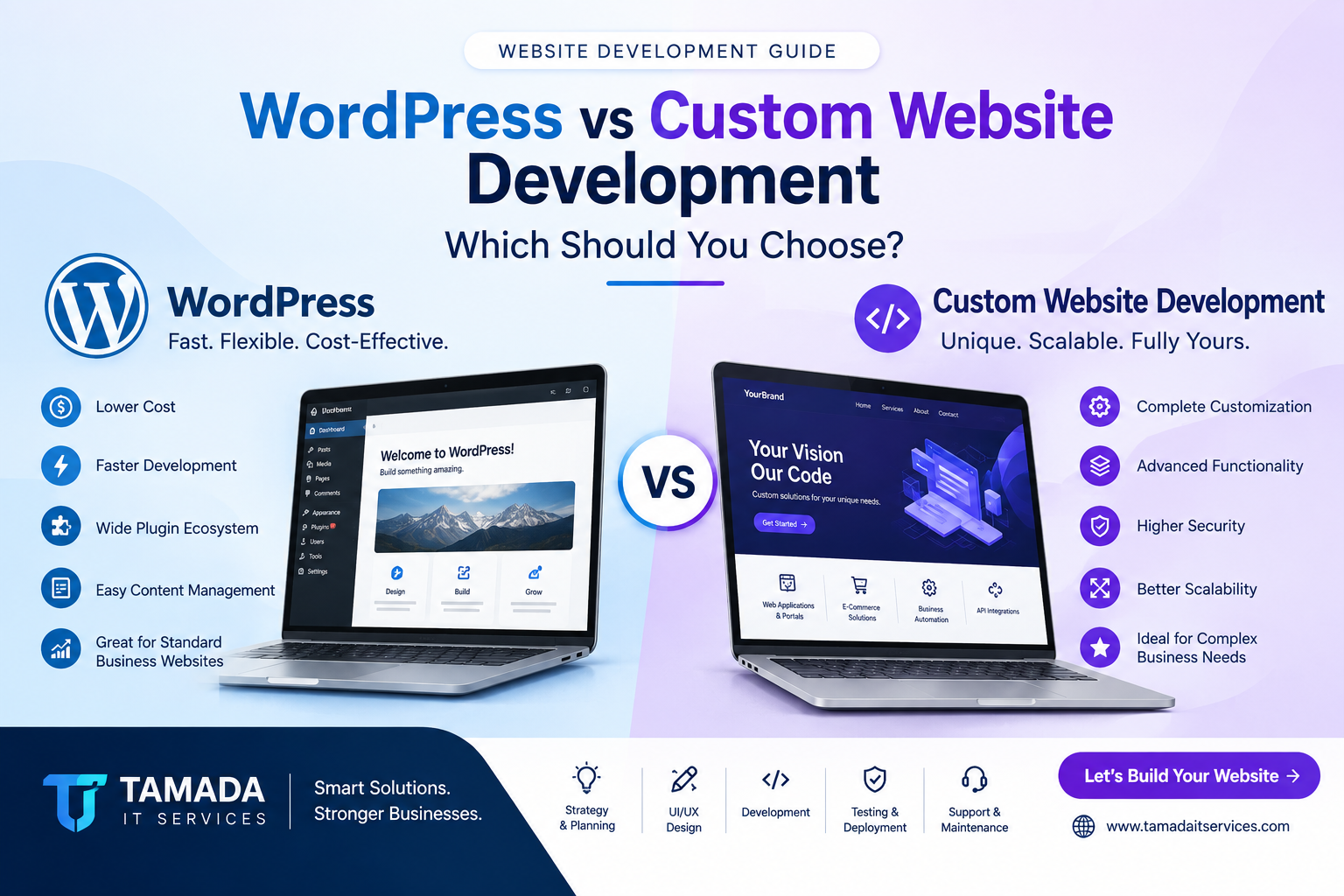
Your website is more than just an online business card. It can be your salesperson, storefront, booking system, lead-generation machine, and first impression—all at the same time.
But when you're ready to build a website, an important question comes up:
Should you use WordPress or build a completely custom website?
For a small business owner, startup founder, entrepreneur, or growing company, choosing the wrong approach can lead to unnecessary costs, limited functionality, slow performance, or expensive redevelopment later.
You may have heard that WordPress is cheap and easy to use.
You may also have heard that custom websites are faster, more secure, and more scalable.
The reality is more balanced.
WordPress can be an excellent choice for many businesses, while custom website development can be the better option for businesses with unique requirements.
The right choice depends on your goals, budget, functionality, expected growth, and how much control you need over the website.
In this guide, we'll compare WordPress vs custom website development and explain the advantages, disadvantages, costs, scalability, SEO, security, maintenance, and ideal use cases for each.
What Is WordPress?
WordPress is a popular content management system (CMS) that allows businesses and individuals to create and manage websites.
Instead of developing every component from scratch, WordPress provides a ready-made foundation.
You can use:
-
Themes
-
Plugins
-
Page builders
-
Forms
-
eCommerce tools
-
SEO plugins
-
Security plugins
-
Analytics integrations
-
Booking systems
-
Membership functionality
This makes WordPress a practical solution for many websites.
A typical WordPress website might include:
WordPress + Theme + Plugins + Customizations
What Is Custom Website Development?Custom website development means creating a website specifically for your business requirements.
Instead of relying primarily on pre-built themes and plugins, developers build the functionality around your requirements.
A custom website may include:
-
Custom UI/UX
-
Custom frontend
-
Custom backend
-
Custom database
-
APIs
-
Business automation
-
Custom dashboards
-
User management
-
Payment systems
-
Third-party integrations
-
Advanced workflows
A custom website can therefore function more like a software application than a traditional website.
For example, if your website needs a unique customer portal, automated business workflow, custom quotation system, employee dashboard, or specialized marketplace functionality, custom development may be more appropriate.
WordPress vs Custom Website: Quick Comparison Factor WordPress Custom Website Initial Cost Usually lower Usually higher Development Speed Faster Longer Customization High with plugins/custom code Very high Design Flexibility High Complete control Scalability Good with proper setup Excellent when architected correctly Maintenance Themes/plugins require updates Developer-managed Plugins Large ecosystem Custom functionality Performance Depends on setup Can be highly optimized Security Requires ongoing updates Custom security strategy Content Management Very easy Can be customized Best For Business sites, blogs, content sites Unique applications and complex businesses 1. Cost: WordPress vs Custom WebsiteCost is often the first consideration for businesses.
WordPress Website Cost
WordPress can be relatively affordable because many components already exist.
You may only need:
-
Domain
-
Hosting
-
Theme
-
Plugins
-
Design customization
-
Development
-
Maintenance
A basic WordPress business website can therefore be launched with a smaller initial budget.
However, costs can increase when you add premium themes, plugins, custom development, advanced integrations, or ongoing maintenance.
Custom Website Development Cost
Custom websites generally require a larger initial investment because developers need to design and build functionality specifically for your business.
Costs can include:
-
UI/UX design
-
Frontend development
-
Backend development
-
Database development
-
APIs
-
Integrations
-
Testing
-
Security
-
Deployment
-
Maintenance
Which Is Cheaper?
WordPress is usually cheaper for standard websites.
Custom development generally costs more initially but may provide greater control and functionality for complex requirements.
2. Development SpeedIf you need a website quickly, WordPress can provide a significant advantage.
A basic website can often be created using an existing theme and customized to match your branding.
Custom development generally takes longer because the development team must build more components specifically for your requirements.
WordPress
Plan → Install → Customize → Configure → Launch
Custom Website
Requirements → UI/UX → Architecture → Development → Testing → Deployment
If your priority is launching quickly, WordPress may be the better option.
If your priority is building something unique, custom development may be worth the additional time.
3. Customization and FlexibilityThis is one of the biggest differences.
WordPress provides extensive customization through themes, plugins, and custom development.
But you're still working within the structure of the WordPress ecosystem.
A custom website gives developers much more freedom.
You can define:
-
How the website works
-
How users interact with it
-
How data is stored
-
How workflows operate
-
How APIs communicate
-
How dashboards function
-
How business logic works
If your website needs functionality that doesn't fit standard WordPress solutions, custom development can be the better approach.
4. DesignBoth approaches can produce professional-looking websites.
WordPress provides thousands of themes and design systems that can be customized.
However, businesses looking for a completely unique experience may prefer custom website development.
With custom development, you can create the user experience specifically around:
-
Your brand
-
Your customers
-
Your products
-
Your workflows
-
Your conversion goals
The result doesn't have to look like a typical WordPress website.
5. ScalabilityThink about where your business will be in three to five years.
A website that works perfectly today may not be sufficient as your business grows.
WordPress can scale successfully when properly configured, optimized, and hosted.
However, highly specialized platforms may eventually require custom architecture.
For example, consider a website that eventually needs:
-
Thousands of users
-
Multiple user roles
-
Real-time data
-
Complex dashboards
-
Custom APIs
-
Large databases
-
Automated workflows
-
Advanced integrations
At that point, custom development may provide more control over the architecture.
Important:
WordPress isn't automatically "not scalable."
The actual scalability depends on the architecture, hosting, plugins, database, caching, code quality, and traffic requirements.
6. SEOBoth WordPress and custom websites can perform well in search engines.
SEO isn't determined simply by the platform.
Important SEO factors include:
-
Page speed
-
Mobile responsiveness
-
Website structure
-
Content quality
-
Internal linking
-
Metadata
-
Schema markup
-
Technical SEO
-
Crawlability
-
Image optimization
-
Core Web Vitals
-
Backlinks
WordPress can make content management and SEO implementation relatively convenient.
A custom website can also be highly SEO-friendly when developers build the correct technical foundation.
Which Is Better for SEO?
Neither automatically wins.
A well-built website with strong SEO fundamentals can perform better than a poorly optimized website regardless of whether it uses WordPress or custom technology.
7. Website PerformanceWebsite speed matters for both users and search engines.
WordPress performance can be affected by:
-
Too many plugins
-
Poor hosting
-
Large images
-
Heavy themes
-
Unoptimized code
-
Excessive scripts
A properly optimized WordPress website can still perform very well.
With custom development, developers have greater control over the code and can build only the functionality required.
However, custom development does not automatically guarantee better performance.
Poorly written custom code can also create performance problems.
The real question is:
How well is the website built and optimized?
8. SecuritySecurity is important regardless of the technology you choose.
WordPress websites require ongoing attention to:
-
WordPress core updates
-
Plugin updates
-
Theme updates
-
Strong passwords
-
Access control
-
Backups
-
Malware monitoring
-
Security configuration
Using outdated plugins or themes can create security risks.
Custom websites can also have vulnerabilities if they aren't designed and maintained properly.
A secure website requires:
-
Secure coding
-
Authentication
-
Authorization
-
Input validation
-
Secure APIs
-
Encryption
-
Regular updates
-
Backups
-
Monitoring
Bottom Line
Neither WordPress nor custom development is automatically secure.
Security depends heavily on implementation and ongoing maintenance.
9. Plugins vs Custom FeaturesOne of WordPress's biggest advantages is its plugin ecosystem.
Need a contact form?
There's a plugin.
Need eCommerce?
There's a plugin.
Need SEO tools?
There's a plugin.
Need booking?
There are plugins.
This can dramatically reduce development time.
But plugins can also introduce problems.
Too many plugins can result in:
-
Performance issues
-
Compatibility problems
-
Security concerns
-
Higher maintenance requirements
-
Plugin conflicts
Custom development avoids relying on plugins for every business-specific requirement.
Instead, functionality can be built directly into the application.
10. Content ManagementWordPress is particularly strong when your website requires frequent content updates.
For example:
-
Blog posts
-
News
-
Articles
-
Pages
-
Images
-
Products
-
Categories
Non-technical team members can manage content without asking developers to modify every page.
This makes WordPress particularly attractive for content-driven businesses.
A custom website can also include a custom CMS or content management system, but this requires additional development.
11. MaintenanceEvery website requires maintenance.
With WordPress, maintenance commonly includes:
-
Core updates
-
Plugin updates
-
Theme updates
-
Backups
-
Security checks
-
Performance optimization
Custom websites may require:
-
Security updates
-
Server maintenance
-
Bug fixes
-
Dependency updates
-
Database maintenance
-
Feature improvements
The maintenance process depends on how the website was built.
A professional development partner should provide a maintenance plan regardless of which technology you choose.
12. IntegrationsYour website may need to communicate with other systems.
Examples include:
-
Payment gateways
-
CRM
-
Accounting software
-
Email marketing
-
WhatsApp
-
SMS
-
Shipping platforms
-
ERP systems
-
Inventory software
-
Analytics
-
Internal business applications
WordPress offers many ready-made integrations.
If your requirements are unusual, however, custom API development may be necessary.
A custom website can be designed around your integration requirements from the beginning.
When Should You Choose WordPress?WordPress can be a great choice if you need a:
Business Website
Ideal for companies that primarily need pages describing their services and business.
Blog
WordPress is particularly well suited to content publishing.
Portfolio Website
Designers, photographers, agencies, and professionals can showcase their work.
Small Business Website
A small company can launch a professional online presence without building a complex software platform.
Content-Driven Website
If publishing articles and managing content is a major requirement, WordPress can be a strong option.
Basic eCommerce Website
WordPress can also be extended into an online store using appropriate eCommerce solutions.
When Should You Choose Custom Website Development?Custom development may be better when you need:
Unique Business Logic
Your business operates differently from standard websites.
Custom Dashboards
You need specialized dashboards for customers, employees, vendors, or administrators.
Complex Workflows
Your business requires automated processes and custom rules.
Advanced Integrations
You need multiple systems to communicate with each other.
Large User Base
You expect substantial usage and require a specialized architecture.
SaaS Platform
You're building software that customers will use as a service.
Marketplace
You need buyers, sellers, commissions, payments, orders, and complex workflows.
Custom Customer Portal
Customers need to log in and access personalized information or services.
Business Automation
Your website needs to automate internal business operations.
Can You Combine WordPress and Custom Development?Yes.
You don't always have to choose one technology for everything.
For example, your company website could use WordPress for:
-
Homepage
-
About page
-
Services
-
Blog
-
SEO content
while a separate custom application handles:
-
Customer login
-
Dashboard
-
Orders
-
Payments
-
Business workflows
This hybrid approach can provide the advantages of both systems.
For example:
WordPress Website → Custom Web Application
This can be a practical strategy for businesses that need strong content management alongside specialized software.
WordPress vs Custom Website: Which Is Better for Small Businesses?For many small businesses, WordPress is a practical starting point.
If you primarily need:
-
Home page
-
About page
-
Services
-
Contact page
-
Blog
-
Basic lead generation
there may be little reason to build a completely custom platform.
However, if your business requires custom workflows, dashboards, customer accounts, advanced integrations, or automation, custom development may be worth considering.
WordPress vs Custom Website: Which Is Better for Startups?Startups should consider their long-term product strategy.
If you need a marketing website to promote your startup, WordPress may be sufficient.
If you're building a software product, SaaS platform, marketplace, or specialized application, custom development may be more appropriate.
A startup could also begin with:
WordPress Marketing Website + Custom MVP
and expand the custom application as the business grows.
Questions to Ask Before ChoosingBefore deciding, ask yourself:
What is the primary purpose of my website?
Is it mainly informational or does it need to perform complex business operations?
How much customization do I need?
Do existing themes and plugins provide what you need?
What's my budget?
Consider both initial development and long-term maintenance.
How quickly do I need to launch?
A simpler WordPress website may launch faster.
Will the website become a software platform?
If yes, custom development may be worth considering early.
Do I need automation?
Complex business automation often points toward custom development.
How important is content management?
If your team publishes content regularly, WordPress can be particularly convenient.
A Simple Decision GuideChoose WordPress if:
-
You need a standard business website.
-
You want to launch quickly.
-
Your budget is limited.
-
You need easy content management.
-
Existing plugins cover your requirements.
-
Your website doesn't require complex business logic.
Choose custom website development if:
-
You need unique functionality.
-
You require complex workflows.
-
You're building SaaS software.
-
You need specialized dashboards.
-
You require extensive integrations.
-
You expect significant technical growth.
-
You need complete control over the application.
One of the biggest mistakes businesses make is choosing technology first.
Instead of saying:
"I want WordPress."
or:
"I want a custom website."
start with:
"What does my business actually need?"
Define:
-
Target audience
-
Website purpose
-
Features
-
User roles
-
Integrations
-
Content requirements
-
Expected traffic
-
Budget
-
Growth plans
Then select the technology that best supports those requirements.
How Tamada IT Services Can HelpAt Tamada IT Services, we help businesses choose and build the right web solution based on their actual requirements.
Depending on your project, we can help with:
-
WordPress website development
-
Custom website development
-
Custom web applications
-
eCommerce development
-
SaaS development
-
Business automation
-
API integrations
-
Customer portals
-
Admin dashboards
-
Database development
-
Website maintenance
-
SEO-friendly website development
We don't believe every business needs a custom website.
And we don't believe every business should use WordPress.
The right technology is the one that solves your business problem effectively and supports your future growth.
If you need a simple professional website, WordPress may be the right choice.
If you need a unique digital platform with custom workflows and functionality, custom development may be the better investment.
Final ThoughtsSo, WordPress vs custom website development—which should you choose?
There isn't one answer for every business.
Choose WordPress when:
Speed + affordability + easy content management are your priorities.
Choose custom development when:
Flexibility + unique functionality + control + scalability are your priorities.
And if you're somewhere in between, a hybrid approach may be the ideal solution.
The most important thing is not choosing the technology that is currently popular.
It's choosing the technology that fits your business, customers, budget, and long-term goals.
A website should not simply exist online.
It should help your business attract customers, generate leads, automate work, improve customer experience, and grow.
Choose the technology based on the business—not the other way around.
Frequently Asked Questions
Is WordPress better than a custom website?
Not necessarily. WordPress is excellent for many standard business and content-driven websites, while custom development is better suited to businesses requiring unique functionality, complex workflows, or specialized applications.
Is WordPress cheaper than custom website development?
Usually, yes for standard websites. WordPress provides a ready-made platform, themes, and plugins, which can reduce initial development costs. Custom websites generally require more development work.
Is a custom website better for SEO?
A custom website can be highly SEO-friendly, but WordPress can also perform very well in search engines. SEO depends on technical implementation, content, performance, site structure, and optimization rather than the platform alone.
Which is faster: WordPress or custom development?
A standard WordPress website can generally be launched faster because many components already exist. Custom development usually takes longer because functionality is built specifically for the project.
Is WordPress secure?
WordPress can be secure when properly configured and maintained. Regular core, theme, and plugin updates, strong authentication, backups, and security monitoring are important.
Can WordPress handle a large business website?
Yes. WordPress can support many business websites when properly designed, hosted, optimized, and maintained. However, highly specialized platforms may eventually benefit from custom architecture.
When should I choose a custom website?
Consider custom development when your website requires unique business logic, advanced integrations, customer dashboards, complex workflows, automation, SaaS functionality, or specialized user experiences.
Can Tamada IT Services build both WordPress and custom websites?
Yes. Tamada IT Services can help businesses with WordPress development, custom website development, web applications, eCommerce, SaaS platforms, integrations, automation, and ongoing maintenance.
Can I start with WordPress and move to custom development later?
Yes. Many businesses start with a simple website and move toward a custom platform as their requirements and customer base grow. Planning the initial architecture carefully can make future transitions easier.