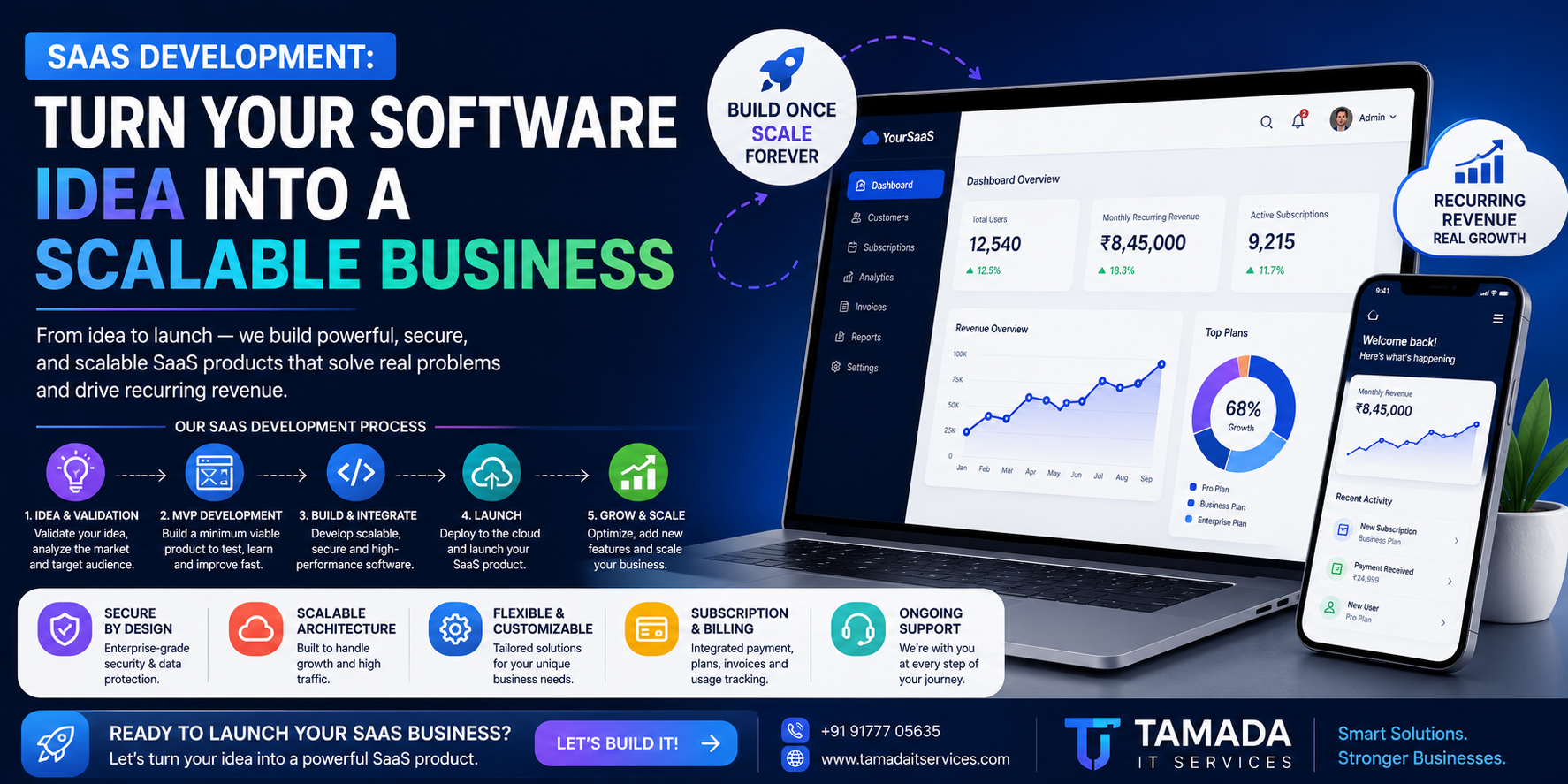
SaaS Development: How to Turn Your Software Idea Into a Business
You have a software idea. But an idea alone isn't a business.
Maybe you've identified a problem that businesses struggle with every day.
Maybe you have an idea for a platform that could save companies time, automate repetitive tasks, manage customers, simplify payments, organize employees, or improve productivity.
You may even have a detailed concept, sketches, features, and a business model in mind.
But then comes the difficult question:
How do you actually turn that software idea into a real SaaS business?
This is where SaaS development comes in.
Software as a Service, commonly known as SaaS, allows businesses to offer software through the internet, usually using a subscription-based model. Customers don't need to install complicated software on their computers. They can simply access the application through a browser or mobile device.
For entrepreneurs and startups, SaaS can provide an opportunity to build a product that serves multiple customers while creating recurring revenue.
However, successful SaaS development requires much more than simply building software.
You need to validate the idea, understand your target customers, define the right features, build an MVP, choose the right technology, create a pricing strategy, launch the product, collect feedback, and continuously improve it.
In this guide, we'll explain how to turn a software idea into a SaaS business, step by step.
What Is SaaS Development?
SaaS development is the process of designing, building, launching, and maintaining software that customers access over the internet.
Instead of selling software as a one-time product, SaaS businesses commonly provide access through a subscription.
For example, a SaaS product could help businesses manage:
-
Customers
-
Employees
-
Projects
-
Invoices
-
Payments
-
Inventory
-
Marketing
-
Sales
-
Documents
-
Appointments
-
Communication
-
Business automation
A typical SaaS customer might:
Visit website → Create account → Choose plan → Subscribe → Use application
The SaaS provider manages the infrastructure, software updates, security, backups, and ongoing improvements.
Why SaaS Is an Attractive Business Model
One of the biggest advantages of SaaS is the possibility of recurring revenue.
Instead of selling a software product once, you can charge customers:
-
Monthly
-
Quarterly
-
Yearly
-
Per user
-
Per organization
-
Based on usage
-
Based on features
For example, imagine a SaaS application with:
100 customers × ₹1,000/month = ₹100,000 monthly recurring revenue
As the customer base grows, recurring revenue can grow as well.
Of course, reaching this stage requires a useful product, strong customer retention, effective marketing, and good execution.
Step 1: Start With a Real Problem
One of the biggest mistakes entrepreneurs make is starting with features instead of problems.
Don't begin with:
"I want to build an application with 50 features."
Start with:
"What problem am I solving, and who has this problem?"
For example:
A business owner spends several hours every week manually creating invoices.
Your SaaS idea could automate invoice creation.
A company struggles to track employees and tasks.
Your SaaS product could provide a centralized task and employee management platform.
A sales team loses leads because follow-ups are forgotten.
Your SaaS application could automate lead follow-ups.
The stronger the problem, the stronger the potential business opportunity.
Step 2: Identify Your Target Customer
You cannot build a successful SaaS product for "everyone."
Define exactly who your first customers are.
Your target audience could be:
-
Small businesses
-
Startups
-
Freelancers
-
Agencies
-
Restaurants
-
Retail businesses
-
Real estate companies
-
Educational institutions
-
Healthcare businesses
-
Manufacturers
-
Sales teams
-
Marketing agencies
-
Enterprises
Ask yourself:
Who experiences this problem most frequently?
Then understand their workflow, challenges, budget, and expectations.
Step 3: Validate Your SaaS Idea
Before spending significant money on development, validate your idea.
This is one of the most important steps in SaaS product development.
You can validate an idea by:
-
Talking to potential customers
-
Conducting surveys
-
Interviewing industry professionals
-
Studying competitors
-
Creating a landing page
-
Running small marketing campaigns
-
Offering early access
-
Collecting email registrations
-
Creating a clickable prototype
Your goal is to answer one critical question:
Will people actually pay for this solution?
An idea can sound excellent in your head but fail when real customers use it.
Validation reduces that risk.
Step 4: Research Your Competitors
Your SaaS idea doesn't necessarily need to be completely unique.
There may already be competitors solving the same problem.
That's not automatically bad.
Competition can actually indicate that customers already spend money in that market.
Study competing products and identify:
-
Their pricing
-
Features
-
Target customers
-
Strengths
-
Weaknesses
-
Customer reviews
-
User complaints
-
Marketing strategy
-
User experience
Then ask:
What can my product do better?
Your competitive advantage could be:
-
Simpler interface
-
Lower cost
-
Better automation
-
Better customer support
-
Industry-specific features
-
Better integrations
-
Faster performance
-
Better reporting
-
Easier setup
Step 5: Define Your MVP
You don't need to build everything on day one.
Instead, create an MVP — Minimum Viable Product.
An MVP contains the essential features needed to solve the core customer problem.
For example, imagine you're building a project management SaaS.
Your initial MVP might include:
-
User registration
-
Login
-
Dashboard
-
Create projects
-
Create tasks
-
Assign tasks
-
Task status
-
Basic notifications
You may not need:
-
AI assistant
-
Advanced analytics
-
Dozens of integrations
-
Complex automation
-
Mobile applications
-
Enterprise permissions
Those features can come later.
Why build an MVP?
Because your first version should help you learn.
Launch → Get feedback → Improve → Add features → Grow.
This is usually more practical than spending a huge amount of money building a massive platform before knowing whether customers want it.
Step 6: Plan Your SaaS Features
Once your MVP is defined, organize the features into priorities.
A simple approach is:
Must Have
Features required for the product to work.
Should Have
Important features that improve the user experience.
Could Have
Useful features that can be added later.
Future Features
Advanced functionality for future versions.
This prevents feature creep, where the project continuously grows in scope and becomes more expensive and difficult to launch.
Step 7: Design the User Experience
A SaaS application should be easy to understand.
Customers shouldn't need a training course just to figure out how to use your dashboard.
The design process may include:
-
User flows
-
Wireframes
-
UI design
-
Dashboard design
-
Mobile responsiveness
-
Navigation
-
Forms
-
Notifications
-
Onboarding
Focus on reducing unnecessary steps.
For example:
Instead of:
Login → Menu → Settings → Customers → Add Customer
you might design:
Dashboard → Add Customer
Small improvements in user experience can make a major difference when thousands of users interact with your product.
Step 8: Choose the Right Technology
Technology decisions can significantly affect the future of your SaaS application.
Depending on the project, your development team may choose technologies for:
Frontend
The part customers interact with.
Examples include modern JavaScript frameworks and responsive web technologies.
Backend
Handles business logic, authentication, APIs, data processing, and integrations.
Database
Stores users, transactions, products, documents, settings, and other application data.
Cloud Infrastructure
Provides servers, storage, databases, backups, monitoring, and scaling.
The right technology depends on:
-
Product requirements
-
Expected traffic
-
Budget
-
Development speed
-
Security
-
Scalability
-
Integrations
-
Long-term maintenance
There isn't one technology stack that is perfect for every SaaS product.
Step 9: Build Secure Authentication
SaaS applications typically manage customer accounts and business information.
Security should therefore be considered from the beginning.
Your SaaS application may require:
-
Secure authentication
-
Password protection
-
Email verification
-
Role-based access
-
Session management
-
Data encryption
-
Secure APIs
-
Regular backups
-
Activity monitoring
-
Security updates
For business SaaS products, protecting customer data isn't an optional feature.
It should be part of the development strategy from day one.
Step 10: Build Multi-Tenant Architecture
Many SaaS applications use a multi-tenant architecture.
This means a single software platform can serve multiple customers while keeping their data logically separated.
For example:
Company A → Users + Data
Company B → Users + Data
Company C → Users + Data
All customers use the same SaaS platform, but each organization has its own environment and data access rules.
A well-planned architecture can make it easier to onboard customers and scale the application as the business grows.
Step 11: Add Subscription and Payment Systems
If your SaaS business uses subscriptions, you'll need a reliable billing system.
Depending on your target market, you may offer:
Free Plan
Limited features for attracting users.
Starter Plan
Designed for individuals or small businesses.
Professional Plan
More features and higher usage limits.
Business Plan
Advanced features for growing organizations.
Enterprise Plan
Custom pricing and advanced requirements.
You can also offer:
-
Monthly billing
-
Annual billing
-
Free trials
-
Discounts
-
Coupons
-
Usage-based pricing
-
Per-user pricing
Your pricing should reflect the value customers receive rather than simply the cost of development.
Step 12: Create an Admin Dashboard
A SaaS business needs more than a customer-facing application.
You also need administrative tools.
An admin dashboard can allow your team to manage:
-
Customers
-
Subscriptions
-
Payments
-
Users
-
Plans
-
Support requests
-
Reports
-
Content
-
System settings
-
Usage statistics
Without proper administration tools, managing a growing SaaS business can become difficult.
Step 13: Test Everything Before Launch
Before releasing your SaaS product, test it thoroughly.
Testing may include:
-
Functional testing
-
UI testing
-
Mobile testing
-
Browser testing
-
Security testing
-
Performance testing
-
Payment testing
-
API testing
-
User acceptance testing
You should also test unusual situations.
For example:
What happens if a payment fails?
What happens if a user's subscription expires?
What happens if a customer cancels?
What happens if hundreds of users access the system simultaneously?
Good testing can prevent expensive problems after launch.
Step 14: Launch With a Small Customer Group
You don't need thousands of users on day one.
Start with a small group of real customers.
Give them access and observe:
-
What they use
-
What they ignore
-
Where they get confused
-
What features they request
-
What problems they encounter
-
Whether they continue using the product
This information is extremely valuable.
Your customers can help you identify improvements that you may never discover during internal development.
Step 15: Measure SaaS Business Metrics
Once your product launches, don't rely only on the number of registered users.
Track meaningful SaaS metrics.
Monthly Recurring Revenue (MRR)
How much recurring subscription revenue you're generating each month.
Customer Churn
How many customers cancel over a period.
Customer Acquisition Cost (CAC)
How much it costs to acquire a customer.
Customer Lifetime Value (LTV)
The estimated revenue generated by a customer during their relationship with your business.
Activation Rate
How many new users actually reach an important product milestone.
Conversion Rate
How many visitors or free users become paying customers.
These metrics help you understand whether your SaaS business is actually growing.
How Much Does SaaS Development Cost?
There is no universal price for developing a SaaS application.
The SaaS development cost depends on factors such as:
-
Product complexity
-
Number of features
-
UI/UX requirements
-
Technology stack
-
User roles
-
Integrations
-
Payment systems
-
Security requirements
-
Cloud infrastructure
-
Admin dashboard
-
Mobile application requirements
-
Development team
-
Testing
-
Ongoing maintenance
A simple SaaS MVP can require significantly less investment than a complex enterprise platform.
The best approach is to first define the MVP and then estimate development based on the actual requirements.
Build vs Buy: Should You Use Existing Software?
Sometimes you don't need to build a SaaS product from scratch.
Existing tools may already solve part of your problem.
However, custom SaaS development makes more sense when:
-
Your idea requires unique functionality
-
Existing software doesn't fit your workflow
-
You need complete control
-
You want to create a commercial software product
-
You need specialized integrations
-
You plan to build a scalable SaaS business
The decision should be based on your business strategy rather than technology alone.
Common SaaS Development Mistakes
Many SaaS startups make similar mistakes.
Building Too Many Features
Trying to launch with everything can delay your product and increase costs.
Skipping Validation
Building before talking to customers can result in a product nobody wants.
Ignoring User Experience
A powerful application is useless if customers find it difficult to use.
Choosing Technology Only Because It's Popular
Technology should solve your specific business requirements.
Underestimating Security
Security problems can damage both your reputation and your business.
Ignoring Support
Customers need help when they encounter problems.
Focusing Only on Development
Building the product is only one part of creating a SaaS company.
You also need:
Marketing + Sales + Customer Support + Retention + Product Improvement
How to Turn a SaaS Product Into a Scalable Business
Building the first version is only the beginning.
Once you have paying customers, focus on:
Customer Feedback
Regularly understand what customers need.
Product Improvements
Improve existing features before constantly adding new ones.
Automation
Automate onboarding, billing notifications, emails, reports, and other repetitive tasks.
Performance
Make sure your application remains fast as usage increases.
Customer Support
Help customers quickly when they face problems.
Marketing
Use SEO, content marketing, social media, advertising, partnerships, and other channels to attract new customers.
Retention
Getting customers is important.
Keeping them is even more important.
Why Work With a SaaS Development Company?
Building SaaS software requires knowledge across multiple areas.
A professional SaaS development company can help with:
-
Product planning
-
Business requirements
-
UI/UX design
-
MVP development
-
Frontend development
-
Backend development
-
Database architecture
-
API development
-
Cloud deployment
-
Payment integration
-
Security
-
Testing
-
Maintenance
-
Scaling
This can help entrepreneurs move from an idea to a working product without having to manage every technical component themselves.
How Tamada IT Services Can Help Turn Your Idea Into SaaS
At Tamada IT Services, we help businesses and entrepreneurs transform software concepts into practical digital products.
If you have an idea for a SaaS platform, we can help you move through the development journey:
Idea → Planning → UI/UX → MVP → Development → Testing → Launch → Improvement
Our approach can include:
-
SaaS product development
-
Custom web application development
-
MVP development
-
Business automation
-
API integrations
-
Admin dashboards
-
Subscription systems
-
Payment integration
-
Database development
-
Cloud deployment
-
Ongoing maintenance
The objective isn't simply to write code.
It's to build a product that solves a real problem and can grow with your business.
Have a SaaS Idea?
You don't need to have everything figured out before starting.
You may only have an idea, a business problem, a few sketches, or a list of features.
That's enough to begin a conversation.
Tamada IT Services can help you evaluate the idea, define the MVP, plan the technology, and develop a SaaS product designed for real-world customers.
Final Thoughts
Turning a software idea into a business isn't a single development project.
It's a journey.
You need to:
Identify a problem → Validate the idea → Understand customers → Define the MVP → Design the product → Develop the SaaS → Test it → Launch → Collect feedback → Improve → Scale
The most successful SaaS products aren't necessarily the ones with the most features.
They are the products that solve meaningful problems for customers and continuously deliver value.
If you have a software idea that could solve a real business problem, the next step isn't necessarily to build everything.
Start small.
Validate the idea.
Build the right MVP.
Get real customers.
Then grow from there.
Your software idea could become your next business.
Frequently Asked Questions
What is SaaS development?
SaaS development is the process of creating software that customers access over the internet, typically through a subscription-based business model.
How do I turn my software idea into a SaaS product?
Start by identifying the problem, defining your target customers, validating the idea, researching competitors, defining an MVP, designing the product, selecting technology, developing the application, testing it, and launching it with real customers.
How much does it cost to build a SaaS application?
The cost depends on the complexity, features, technology, integrations, security requirements, design, and development team. Defining an MVP first is the best way to create a realistic development estimate.
Should I build an MVP before the full SaaS product?
Yes, in many cases an MVP is a practical starting point. It allows you to test your idea with real customers before making a larger investment.
How long does SaaS development take?
Development time varies significantly depending on the scope. A focused MVP can be developed much faster than a complex SaaS platform with extensive integrations and advanced functionality.
Can a SaaS product generate recurring revenue?
Yes. SaaS businesses commonly use subscription models such as monthly or annual plans, although the actual revenue potential depends on pricing, customer acquisition, retention, product value, and market demand.
Do I need a technical background to start a SaaS business?
No. Entrepreneurs without technical backgrounds can work with a SaaS development company or technical development team to turn their product concept into software.
Can my SaaS application be expanded later?
Yes. A well-designed SaaS platform can evolve over time with new features, integrations, automation, analytics, mobile applications, additional subscription plans, and improved infrastructure.
What makes a SaaS product successful?
A successful SaaS product typically solves a real problem, provides clear value, delivers a good user experience, has reliable technology, attracts the right customers, and continuously improves based on customer feedback.