Have a mobile app idea but don't know how much it will cost to turn it into reality?
You're not alone.
For a startup founder, business owner, entrepreneur, or company planning digital transformation, one of the first questions is usually:
"How much does it cost to develop a mobile app in India?"
You may find one company offering to build an app for ₹50,000, another quoting ₹2 lakh, and another estimating ₹10 lakh or more.
So which price is actually correct?
The truth is that there is no single fixed price for mobile app development.
The final cost depends on what you're building, how complex the application is, which platforms you need, how many features are required, the design quality, integrations, security requirements, and the development team you choose.
A simple business app can cost considerably less than a marketplace, fintech platform, healthcare application, social network, or enterprise mobile application.
In this guide, we'll break down mobile app development costs in India, the factors that affect pricing, different types of apps, additional expenses, and ways to build your app without wasting your budget.
Mobile App Development Cost in India: An Overview
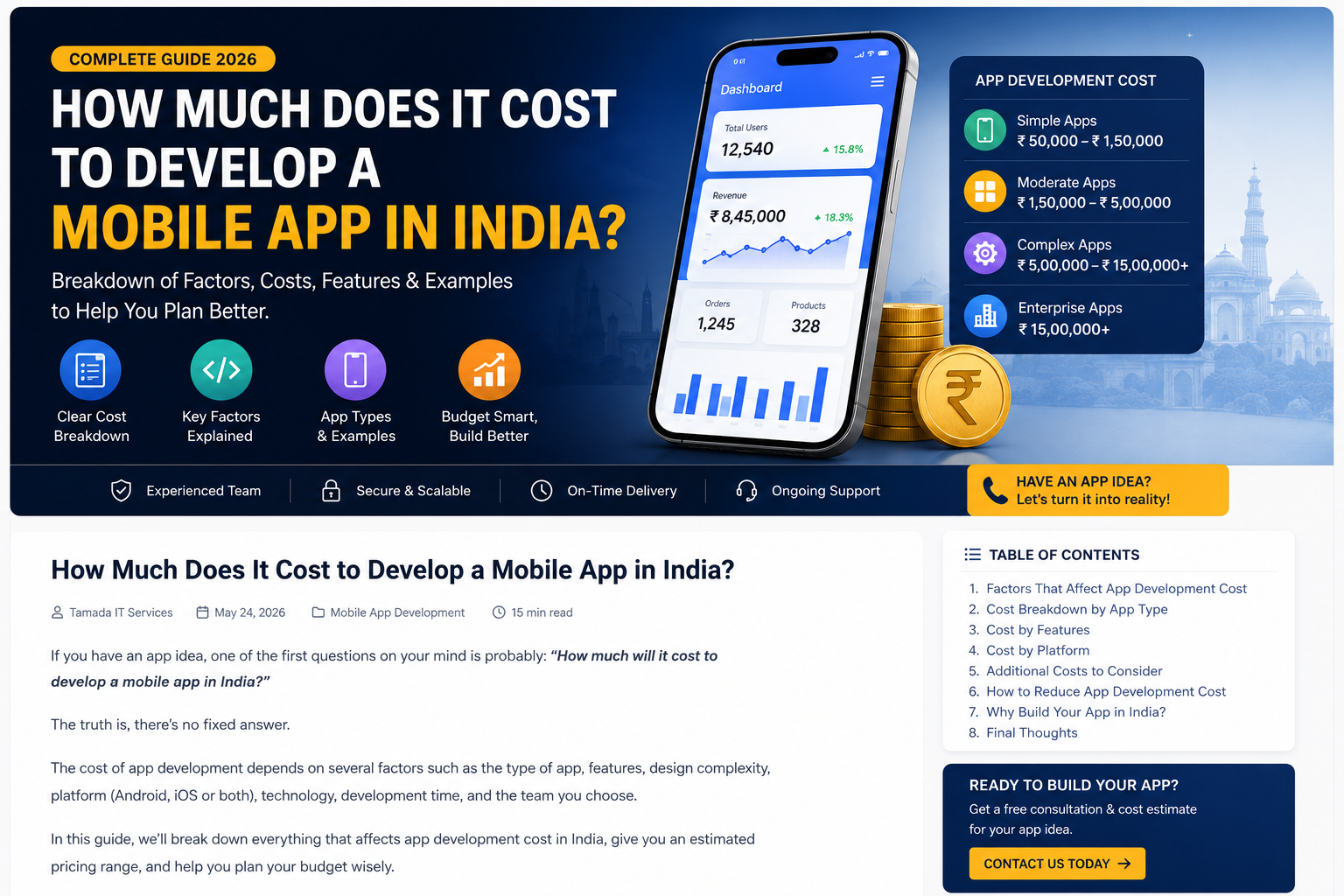
As a general planning guide, mobile app development projects in India can fall into several broad ranges depending on complexity.
App Type Approximate Development Range Simple App ₹50,000 – ₹1,50,000+ Basic Business App ₹1,00,000 – ₹3,00,000+ Medium-Complexity App ₹2,50,000 – ₹6,00,000+ Complex Custom App ₹5,00,000 – ₹15,00,000+ Enterprise-Level App ₹15,00,000+These are planning ranges, not fixed quotes.
The actual mobile app development cost in India can be lower or higher depending on your requirements.
For example, an app with login, profiles, a few screens, and basic content will generally require much less development work than an application involving real-time chat, payments, GPS tracking, multiple user roles, advanced dashboards, and third-party integrations.
What Determines Mobile App Development Cost?Several factors influence the final price of an app.
The most important ones include:
-
App complexity
-
Number of features
-
UI/UX design
-
Android and/or iOS development
-
Backend development
-
Database requirements
-
APIs and integrations
-
Payment systems
-
Security
-
Admin dashboard
-
Testing
-
Deployment
-
Maintenance and updates
Let's look at each factor.
1. Complexity of the Mobile AppThe complexity of your application is one of the biggest factors affecting development cost.
Simple Apps
A simple application might include:
-
Login
-
Basic user profile
-
Static content
-
A few screens
-
Contact form
-
Basic notifications
These applications generally require less development time.
Medium-Complexity Apps
A medium-level application might include:
-
User registration
-
Profiles
-
Search
-
Filters
-
Database
-
Notifications
-
Payments
-
API integrations
-
Admin panel
-
Multiple user roles
These require considerably more planning and development.
Complex Apps
Complex applications may include:
-
Real-time communication
-
GPS tracking
-
Advanced payments
-
AI features
-
Video streaming
-
Complex business logic
-
Multiple user types
-
Real-time dashboards
-
Advanced analytics
-
Large databases
-
Third-party integrations
These projects require significantly more development, testing, security, and infrastructure.
2. Features Directly Affect App Development CostEvery feature adds development work.
For example, a basic app might only need:
Login → Dashboard → Profile → Contact
But adding features such as:
-
Online payments
-
Push notifications
-
Chat
-
Location tracking
-
Booking
-
Reviews
-
Ratings
-
Subscription plans
-
Coupons
-
Referral systems
-
AI
-
Analytics
-
File uploads
can increase the development effort.
This is why defining your features before development is extremely important.
3. UI/UX DesignYour app's design can also influence development cost.
A basic interface may require relatively little design work.
A highly customized application may require:
-
User research
-
Wireframes
-
Prototypes
-
Custom illustrations
-
Design systems
-
Animations
-
Micro-interactions
-
Multiple device layouts
-
Accessibility considerations
Good UI/UX isn't simply about making an app look attractive.
It should make the application easy and intuitive to use.
A beautiful app that users don't understand isn't a successful app.
4. Android vs iOS DevelopmentAnother major consideration is the platform.
You may want:
-
Android only
-
iOS only
-
Android + iOS
Developing separate native applications for Android and iOS can increase the overall budget.
Alternatively, cross-platform technologies can sometimes allow businesses to build applications for multiple platforms using a shared codebase.
The best approach depends on:
-
App requirements
-
Performance expectations
-
Budget
-
Target customers
-
Required device features
-
Long-term product plans
Many people think mobile app development is simply about creating the screens users see.
That's only one part of the project.
Most serious applications require a backend.
The backend may manage:
-
Users
-
Authentication
-
Products
-
Orders
-
Payments
-
Messages
-
Notifications
-
Reports
-
Subscriptions
-
Business logic
-
Databases
For example, when a user places an order through a mobile app, the backend may process the order, store the information, notify the business, update inventory, and generate payment records.
This backend development contributes significantly to the total project cost.
6. Admin DashboardIf you're building a business application, you will often need an admin panel.
An admin dashboard can allow your team to manage:
-
Users
-
Products
-
Orders
-
Payments
-
Content
-
Reports
-
Notifications
-
App settings
-
Customer support
For example:
Mobile App → API → Database → Admin Dashboard
This gives your business control over the application without requiring developers to manually modify data.
7. Third-Party IntegrationsYour app may need to communicate with other services.
Common integrations include:
-
Payment gateways
-
Google Maps
-
WhatsApp
-
Email services
-
SMS providers
-
Social login
-
Cloud storage
-
CRM systems
-
Accounting software
-
Analytics platforms
-
Shipping providers
Each integration requires development and testing.
Some third-party services may also charge their own usage or transaction fees.
8. Payment IntegrationIf your application involves transactions, you may need online payment functionality.
For example:
-
Product purchases
-
Subscription plans
-
Booking payments
-
Service payments
-
In-app purchases
-
Memberships
Payment integration requires additional development and testing to ensure that transactions are processed correctly.
Security is especially important when dealing with financial transactions.
9. Push NotificationsPush notifications can help businesses communicate with users.
For example:
"Your order has been shipped."
"Your appointment is tomorrow."
"New offer available."
"Your subscription expires soon."
Notifications can be triggered based on user activity, business events, or scheduled campaigns.
While the basic implementation may be straightforward, complex notification systems can require additional backend logic.
10. Security RequirementsSecurity should never be treated as an optional feature.
Depending on your application, security requirements may include:
-
Secure authentication
-
Password protection
-
Data encryption
-
API security
-
Role-based access
-
Secure payment processing
-
Session management
-
Data backups
-
Monitoring
-
Security updates
Applications handling financial, customer, healthcare, business, or other sensitive information may require additional security considerations.
Mobile App Development Cost by App TypeDifferent types of applications require different levels of development effort.
Business App
A basic business application may include company information, services, contact features, user accounts, and notifications.
Typical complexity: Low to medium.
E-Commerce App
An eCommerce application may include:
-
Product catalog
-
Search
-
Filters
-
Cart
-
Checkout
-
Payments
-
Orders
-
Delivery tracking
-
Coupons
-
Reviews
-
Notifications
Typical complexity: Medium to high.
Food Delivery App
A food delivery platform can involve multiple applications or user roles:
Customer App
Restaurant Panel
Delivery App
Admin Dashboard
Features may include:
-
Restaurant listings
-
Menu management
-
Ordering
-
Online payments
-
GPS tracking
-
Delivery management
-
Notifications
This makes the project considerably more complex.
Marketplace App
A marketplace connects buyers and sellers.
It may require:
-
Buyer accounts
-
Seller accounts
-
Product listings
-
Search
-
Messaging
-
Payments
-
Reviews
-
Commission management
-
Order management
-
Notifications
-
Admin controls
Marketplace applications can require significant backend development.
Booking App
Booking applications may be used by:
-
Hotels
-
Clinics
-
Salons
-
Consultants
-
Trainers
-
Service providers
-
Event businesses
Features can include:
-
Calendar
-
Availability
-
Booking
-
Cancellation
-
Payments
-
Notifications
-
Customer accounts
-
Admin management
SaaS Mobile App
If you're building a SaaS product, the mobile application may connect to an existing web-based SaaS platform.
It may include:
-
User accounts
-
Dashboard
-
Subscription management
-
Notifications
-
Reports
-
Data synchronization
-
Role-based access
The complexity depends heavily on the existing SaaS architecture.
What About the Cost of Android App Development?If your target audience primarily uses Android devices, you may start with an Android application.
The Android app development cost in India depends on the same major factors:
-
Features
-
Design
-
Backend
-
APIs
-
Integrations
-
Security
-
Testing
-
Development technology
Starting with Android can sometimes be a practical strategy for businesses with a limited initial budget, followed by an iOS version later.
What About iOS App Development Cost?iOS development has its own technical requirements and testing considerations.
The cost depends on:
-
Number of screens
-
Features
-
Backend
-
APIs
-
Device support
-
Payment functionality
-
Notifications
-
Security
-
Testing
-
App Store deployment
If your target customers primarily use Apple devices, an iOS-first strategy may make sense.
Should You Build Android and iOS Together?It depends on your business.
Building for both platforms from the beginning can help you reach a larger audience.
However, it can also increase the initial development scope.
For startups, another approach is:
Build MVP → Launch → Validate → Improve → Expand
For example:
Phase 1
Android application
Phase 2
iOS application
Phase 3
Web application
Phase 4
Advanced features
This phased approach can help manage the initial investment.
Additional Costs You Should ConsiderThe development quote isn't necessarily the only cost involved.
Your total mobile app budget may also include:
App Store Accounts
Publishing applications requires developer accounts for the relevant platforms.
Server and Cloud Costs
Your backend may require cloud hosting, databases, storage, backups, and monitoring.
Domain and Website
A landing website is often useful for your app.
SMS and Email
OTP verification, alerts, and transactional messages may have usage costs.
Payment Gateway Fees
Payment providers may charge transaction fees.
Maintenance
Your application will require updates after launch.
Marketing
Building the app doesn't automatically bring users.
You may also need to budget for:
-
SEO
-
Social media
-
Advertising
-
Content marketing
-
Influencer campaigns
-
App Store optimization
Launching your app is not the end of development.
Operating systems change.
Devices change.
Security requirements evolve.
Third-party APIs can change.
Users request new features.
Your app therefore needs ongoing maintenance.
Maintenance may include:
-
Bug fixes
-
Security updates
-
Performance improvements
-
OS compatibility
-
Server maintenance
-
Database maintenance
-
New features
-
UI improvements
-
Monitoring
-
Backups
A good development plan should consider these costs from the beginning.
How to Reduce Mobile App Development CostYou don't necessarily need to spend a huge amount to launch your first version.
Here are some practical strategies.
1. Start With an MVP
Build the essential features first.
Avoid unnecessary features during the initial release.
2. Prioritize Features
Separate features into:
Must Have
Should Have
Nice to Have
Future
This helps control scope.
3. Use a Cross-Platform Approach When Appropriate
Depending on your requirements, cross-platform development can reduce duplicated development effort.
However, it should be selected based on technical requirements rather than cost alone.
4. Reuse Existing Services
Instead of building every component from scratch, you may be able to integrate established services for:
-
Payments
-
Maps
-
Notifications
-
Authentication
-
Analytics
-
Email
-
SMS
This can reduce development time.
5. Plan Before Development
Poor planning is one of the easiest ways to increase development costs.
Before writing code, define:
-
Target users
-
Features
-
User journeys
-
Platforms
-
Design requirements
-
Backend requirements
-
Integrations
-
Budget
-
Launch strategy
A few hours of planning can prevent weeks of unnecessary development.
How Long Does It Take to Develop a Mobile App?Development time varies depending on complexity.
A simple application may take several weeks.
A medium-complexity application may take a few months.
A complex application can take considerably longer.
The timeline depends on:
-
Number of features
-
UI/UX complexity
-
Backend requirements
-
Platform count
-
Integrations
-
Testing
-
Client feedback
-
Development team size
A reliable development company should provide a realistic timeline after understanding your requirements.
How to Choose a Mobile App Development Company in IndiaChoosing the right development partner is just as important as choosing the right technology.
Before hiring a company, check:
Portfolio
Look at their previous applications.
Technical Experience
Make sure they understand the technology required for your project.
Communication
Clear communication can prevent misunderstandings.
Development Process
Ask how they handle planning, design, development, testing, and launch.
Pricing
Don't choose a company purely because it offers the lowest price.
Support
Ask what happens after the application is launched.
Ownership
Make sure you understand who owns the source code, design assets, domain, and other project materials.
Security
Ask how user data and application security will be handled.
Why the Cheapest App Development Quote May Not Be the BestSuppose one company quotes:
₹75,000
and another quotes:
₹3,00,000
It may be tempting to choose the cheaper option.
But compare what you're actually getting.
The lower quote may exclude:
-
UI/UX design
-
Backend development
-
Admin panel
-
Testing
-
Security
-
Deployment
-
Support
-
Third-party integrations
Always compare the scope of work, not just the final price.
A professional app should be evaluated based on its long-term value, reliability, scalability, and ability to support your business.
A Better Way to Plan Your App BudgetInstead of asking:
"How cheaply can I build this app?"
ask:
"What is the smallest version of this app that can solve the customer's problem?"
This mindset can help you build an MVP without unnecessary spending.
For example:
Original Idea
20+ features
MVP
5–7 essential features
First Launch
Real customers + real feedback
Version 2
Improve existing features
Version 3
Add advanced functionality
This approach allows your product to evolve based on actual customer needs.
Should You Build a Mobile App for Your Business?A mobile application may be worth considering if your business needs:
-
Regular customer interaction
-
Online ordering
-
Booking
-
Payments
-
Customer accounts
-
Loyalty programs
-
Notifications
-
Location-based services
-
Employee management
-
Business automation
-
Subscription services
-
Custom workflows
However, not every business needs an app immediately.
Sometimes a professional website or web application may be a better first step.
The right choice depends on your business model and customer behavior.
How Tamada IT Services Can HelpAt Tamada IT Services, we help businesses, startups, and entrepreneurs turn software ideas into practical mobile applications.
Our development process can cover:
Idea → Planning → UI/UX Design → Development → Testing → Deployment → Support
We can help with:
-
Android app development
-
iOS app development
-
Cross-platform applications
-
Custom mobile applications
-
Backend development
-
API integration
-
Payment integration
-
Admin dashboards
-
Business automation
-
SaaS applications
-
Database development
-
App maintenance
Whether you're building your first MVP or developing a complete business application, the goal is to create software that solves a real problem and provides measurable value.
Have a Mobile App Idea?
You don't need to know exactly how the technology should work.
Start with your idea.
Tell us:
-
What problem are you solving?
-
Who are your customers?
-
What should the app do?
-
Which platform do you need?
-
What is your expected budget?
From there, the project can be converted into a practical development plan.
Tamada IT Services can help turn your mobile app idea into a secure, scalable, and user-friendly application.
Final ThoughtsSo, how much does it cost to develop a mobile app in India?
There isn't one universal answer.
A simple app might require a relatively small investment, while a complex marketplace, SaaS platform, financial application, or enterprise solution can require significantly more.
The final cost depends on:
Features + Design + Platform + Backend + Integrations + Security + Testing + Development Team
The smartest approach isn't necessarily to build the cheapest app.
It's to build the right app.
Start with the core problem.
Define your MVP.
Prioritize the essential features.
Choose the right technology.
Work with an experienced development team.
Launch.
Collect feedback.
Then improve and scale.
A well-planned mobile application can become much more than a digital product—it can become an important part of your business.
Frequently Asked Questions
How much does it cost to develop a mobile app in India?
Mobile app development costs can range from around ₹50,000 for a simple application to ₹15 lakh or more for complex applications. The actual price depends on features, design, platform, backend, integrations, and development requirements.
What is the average cost of developing an Android app in India?
There is no fixed average because Android apps vary significantly in complexity. A simple business app may cost much less than an eCommerce, marketplace, or enterprise application.
Is iOS app development more expensive than Android?
Not necessarily. The cost depends more on the application's features, architecture, design, integrations, and development approach than simply the platform.
How much does a basic mobile app cost?
A basic mobile application with limited screens and functionality can start from approximately ₹50,000, although the final cost depends on the exact requirements.
How much does an eCommerce mobile app cost?
An eCommerce app can cost significantly more than a basic application because it may require product management, search, cart, payments, orders, notifications, customer accounts, and an admin system.
How long does it take to develop a mobile app?
Simple apps may take several weeks, while medium and complex applications can take several months or longer. The timeline depends on the scope and development process.
Can I reduce app development costs?
Yes. Starting with an MVP, prioritizing features, using appropriate cross-platform technology, reusing established third-party services, and planning requirements carefully can help control costs.
Do mobile apps require ongoing maintenance?
Yes. Applications need ongoing updates for operating-system compatibility, security, bug fixes, performance, server infrastructure, and new features.
Should a startup build an MVP first?
For many startups, an MVP is a practical approach. It allows you to validate the product with real users before investing heavily in advanced functionality.
Can Tamada IT Services develop custom mobile apps?
Yes. Tamada IT Services can help businesses and startups with custom mobile app development, backend systems, APIs, admin dashboards, integrations, deployment, and ongoing support.