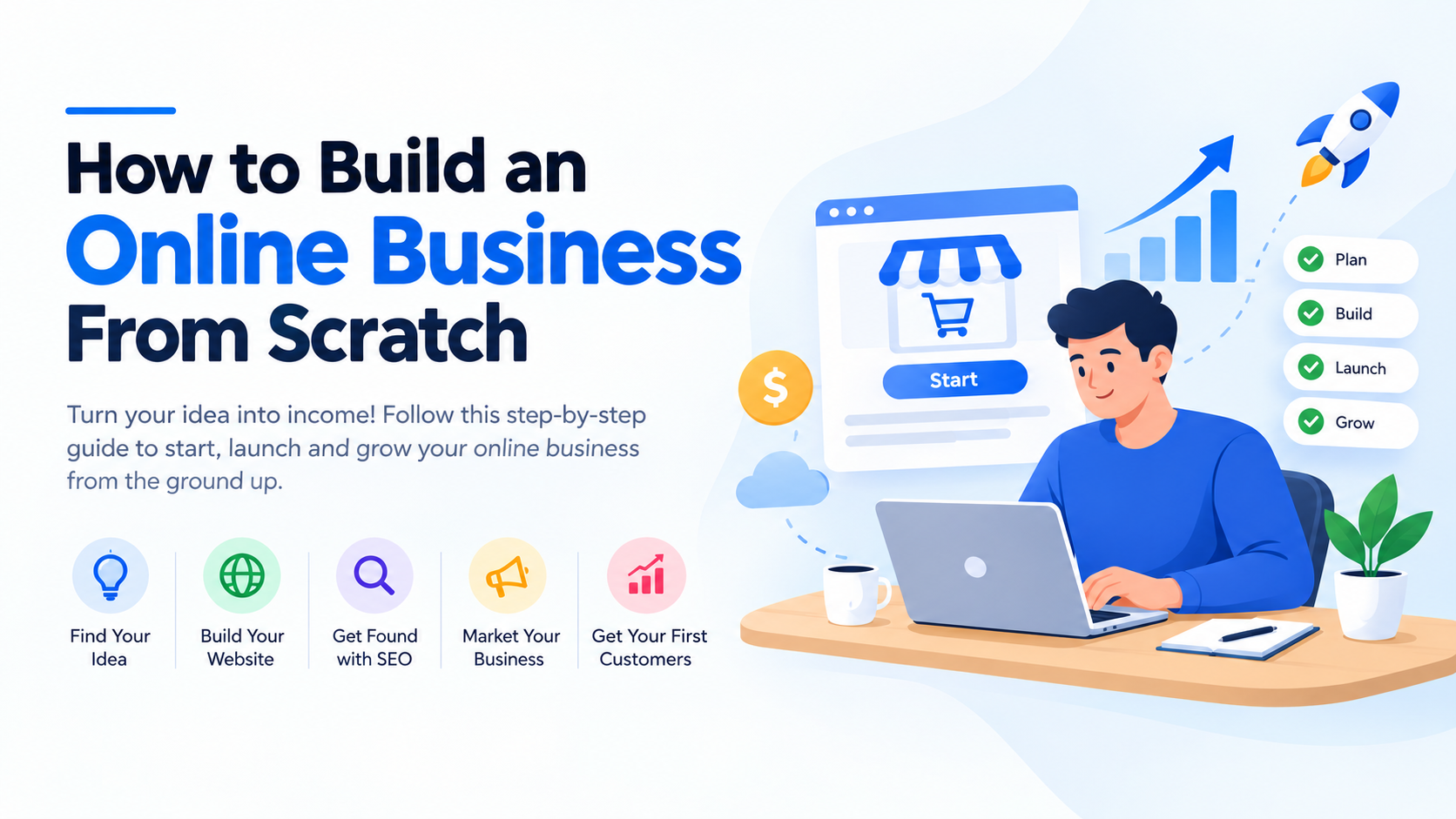
Starting an online business can seem overwhelming.
You may have an idea, a skill, a product, or a service—but turning that idea into a real business requires more than simply creating a website and posting on social media.
If you're a first-time entrepreneur, freelancer, startup founder, small business owner, or someone looking for a new digital business opportunity, the good news is that you don't need a huge company or a massive budget to get started.
You need a clear problem to solve, the right audience, a practical business model, and a consistent plan for execution.
In this guide, we'll walk through how to build an online business from scratch—from choosing your idea to launching, getting your first customers, automating operations, and eventually scaling.
What Is an Online Business?
An online business is a business that uses the internet as an important part of its operations, sales, marketing, delivery, or customer service.
Examples include:
-
E-commerce stores
-
SaaS products
-
Online courses
-
Consulting businesses
-
Freelance services
-
Digital agencies
-
Web development companies
-
Mobile app businesses
-
Subscription businesses
-
Digital product stores
-
Affiliate businesses
-
Online marketplaces
-
Content-based businesses
Some businesses operate entirely online, while others use the internet to support a traditional physical business.
The important thing is that the internet becomes a major channel for reaching customers and delivering value.
Step 1: Start With a Problem, Not Just an IdeaOne of the biggest mistakes new entrepreneurs make is starting with a product instead of a problem.
For example:
Weak approach:
"I want to build an app."
Better approach:
"Small businesses are spending hours manually managing customer inquiries, and I want to create a system that automates the process."
The second approach gives you a clear direction.
Before building anything, ask:
-
What problem am I solving?
-
Who experiences this problem?
-
How are they solving it today?
-
How much does the problem cost them?
-
Would they pay for a better solution?
-
Can I provide that solution better or differently?
A strong business usually starts with a real problem.
Step 2: Choose Your Target CustomerYou can't effectively sell to everyone.
Define exactly who your ideal customer is.
For example:
Instead of:
"We provide software for businesses."
Try:
"We provide workflow automation software for small service businesses that want to reduce manual administrative work."
The second description is much more specific.
Consider your target customer's:
-
Age or business stage
-
Industry
-
Location
-
Budget
-
Problems
-
Goals
-
Buying behavior
-
Technology experience
-
Current solutions
The more clearly you understand your customer, the easier it becomes to create your product, website, marketing, and messaging.
Step 3: Research Your MarketBefore investing significant time and money, research the market.
Look at existing businesses offering similar products or services.
Study:
-
Their pricing
-
Features
-
Website
-
Customer reviews
-
Marketing strategy
-
Social media presence
-
Strengths
-
Weaknesses
-
Customer complaints
Competitors aren't necessarily bad news.
Competition can actually indicate that customers are already spending money in the market.
Your goal isn't always to eliminate competition.
Instead, find an opportunity to offer something better, simpler, faster, more specialized, or more convenient.
Step 4: Choose the Right Online Business ModelYour business model determines how you make money.
Some common online business models include:
Business Model How You Make Money E-commerce Sell physical products SaaS Monthly or yearly subscriptions Freelancing Charge for services Consulting Charge for expertise Digital products Sell templates, guides, or resources Online courses Sell educational content Marketplace Commission or transaction fees Subscription Recurring customer payments Agency Monthly or project-based services Affiliate marketing Earn commissions from referralsChoose a model that matches your skills, resources, market, and long-term goals.
Step 5: Validate Your Business IdeaDon't spend six months building something that nobody wants.
Validate your idea before investing heavily.
You can start by:
-
Talking to potential customers
-
Creating a landing page
-
Running a small advertising campaign
-
Offering a basic version of the service
-
Collecting email signups
-
Taking pre-orders
-
Publishing educational content
-
Asking potential customers for feedback
The goal is to answer one important question:
"Do people actually want this?"
Real customer behavior is generally more valuable than assumptions.
Step 6: Build a Minimum Viable ProductIf you're building software, SaaS, or an online platform, you don't necessarily need every feature on day one.
Start with an MVP—Minimum Viable Product.
An MVP contains the core features needed to solve the main customer problem.
For example, if you're building a simple appointment platform, your first version might only need:
-
User registration
-
Service listing
-
Appointment booking
-
Notifications
-
Basic dashboard
You may not need dozens of advanced features initially.
Build the core solution.
Launch it.
Collect feedback.
Then improve it.
This approach can save time, reduce development costs, and help you understand what customers actually need.
Step 7: Create a Professional WebsiteYour website is often the foundation of your online presence.
A professional business website should clearly communicate:
What you offer + Who it's for + Why customers should choose you + What they should do next
Depending on your business, your website may include:
-
Homepage
-
About page
-
Services or products
-
Pricing
-
Contact page
-
Blog
-
Testimonials
-
FAQ
-
Portfolio
-
Login or customer dashboard
-
Payment system
Your website should also be:
-
Mobile-friendly
-
Fast
-
Secure
-
Easy to navigate
-
Search-engine friendly
-
Professionally designed
Don't think of your website simply as an online brochure.
It can become a sales, marketing, customer-support, and automation platform for your business.
Step 8: Build Your BrandYour brand is more than a logo.
It includes how customers perceive your business.
Develop consistent:
-
Business name
-
Logo
-
Colors
-
Typography
-
Visual style
-
Tone of communication
-
Brand message
-
Value proposition
Your website, social media profiles, emails, advertisements, and marketing materials should feel like they belong to the same business.
A consistent brand can help make your business easier to recognize and remember.
Step 9: Set Up PaymentsIf you're selling online, customers need a simple way to pay.
Depending on your business model, you may use:
-
Online payment gateways
-
Credit and debit cards
-
Bank transfers
-
Digital wallets
-
Subscription billing
-
Payment links
-
E-commerce checkout
Make the payment process as simple as possible.
The more complicated checkout becomes, the greater the chance that customers abandon their purchase.
Also make sure your payment process clearly communicates:
-
Pricing
-
Taxes where applicable
-
Refund policies
-
Subscription terms
-
Confirmation details
Having a website doesn't automatically bring customers.
People need to discover your business.
Build an online presence around the platforms where your target customers spend time.
Depending on your audience, this could include:
-
Google search
-
LinkedIn
-
Instagram
-
YouTube
-
Facebook
-
X
-
Industry communities
-
Email newsletters
You don't need to be everywhere.
Start with one or two channels where your ideal customers are most active.
Step 11: Use SEO to Get DiscoveredSearch engine optimization can help potential customers discover your business when they search for relevant information or services.
For example, if you offer website development, you might create content around topics such as:
-
Website development cost
-
How to choose a web development company
-
Business website benefits
-
Website maintenance
-
WordPress vs custom website
-
How to improve website performance
SEO is a long-term strategy.
Instead of constantly paying to reach customers, useful content can continue attracting relevant visitors over time.
Important SEO areas include:
-
Keyword research
-
Helpful content
-
Page titles
-
Meta descriptions
-
Internal linking
-
Website speed
-
Mobile usability
-
Technical SEO
-
Image optimization
-
Backlinks
-
Search intent
Content marketing can help establish authority and attract potential customers.
You can create:
-
Blog articles
-
Videos
-
Tutorials
-
Case studies
-
Guides
-
Checklists
-
Social media posts
-
Newsletters
-
Webinars
-
Product demonstrations
Don't create content simply to fill your website.
Create content that answers questions your potential customers are already asking.
For example:
If you sell accounting software, instead of only writing about your product, create content such as:
"How Small Businesses Can Organize Their Monthly Expenses"
The person searching for that information may eventually become a customer.
Step 13: Get Your First CustomersYour first customers may not come from large advertising campaigns.
You can start with:
Personal Network
Tell people you know about your business.
Direct Outreach
Contact potential customers with a personalized message.
Social Media
Share useful content and demonstrate your expertise.
Communities
Participate in relevant professional communities.
Partnerships
Work with complementary businesses.
Content Marketing
Create useful resources that attract your target audience.
Search Engines
Build long-term organic traffic through SEO.
The goal isn't simply to get traffic.
The goal is to get the right traffic.
Step 14: Track Your NumbersOnce your business starts operating, measure what is happening.
Important metrics can include:
-
Website visitors
-
Leads
-
Conversion rate
-
Customer acquisition cost
-
Average order value
-
Revenue
-
Profit margin
-
Customer retention
-
Subscription cancellations
-
Repeat purchases
For SaaS businesses, you may also monitor:
-
Monthly recurring revenue
-
Annual recurring revenue
-
Churn
-
Customer lifetime value
-
Trial-to-paid conversion
Numbers help you identify what's working and what needs improvement.
Step 15: Automate Repetitive TasksAs your business grows, manual work can become a major problem.
You may find yourself repeatedly:
-
Sending emails
-
Updating spreadsheets
-
Creating invoices
-
Following up with leads
-
Answering common questions
-
Updating customer records
-
Sending notifications
-
Preparing reports
This is where business automation can make a major difference.
For example:
New customer signs up
↓
Customer information is added to CRM
↓
Welcome email is sent
↓
Invoice is generated
↓
Payment is recorded
↓
Account is created
↓
Team receives notification
↓
Customer receives onboarding instructions
A properly designed workflow can perform these steps automatically.
Step 16: Use Technology to ScaleTechnology can help an online business handle increasing demand without increasing manual work at the same rate.
Depending on your business, you may eventually need:
-
CRM software
-
Customer portals
-
Mobile applications
-
SaaS platforms
-
Inventory management
-
Payment integrations
-
Analytics dashboards
-
Automated email systems
-
AI-powered workflows
-
Custom business software
The goal is to create systems that allow the business to grow efficiently.
Step 17: Focus on Customer ExperienceGetting a customer is only the beginning.
You also need to give them a reason to stay.
Focus on:
-
Fast communication
-
Easy onboarding
-
Simple payments
-
Reliable service
-
Helpful support
-
Clear documentation
-
Regular updates
-
Easy refunds or cancellations where appropriate
-
Listening to feedback
A happy customer can become a repeat customer and may also recommend your business to others.
Step 18: Improve Your Business ContinuouslyYour first version won't be perfect.
And it doesn't need to be.
Successful online businesses continuously improve their:
-
Product
-
Website
-
Pricing
-
Customer experience
-
Marketing
-
Technology
-
Processes
-
Content
Listen to customers.
Study your data.
Identify bottlenecks.
Test improvements.
Then repeat.
This creates a cycle of continuous growth.
Common Mistakes When Starting an Online BusinessTrying to Be Perfect Before Launching
Many entrepreneurs spend too much time perfecting their product before showing it to customers.
Launch a practical version and improve based on feedback.
Targeting Everyone
A specific audience makes marketing and product development much easier.
Building Without Validation
Don't assume customers will pay simply because you think an idea is good.
Validate it first.
Ignoring Marketing
A great product won't grow if nobody knows it exists.
Marketing should be part of the business plan from the beginning.
Depending on One Platform
Don't build your entire business around a single social media platform or marketplace.
Build assets you control, especially your website and customer database.
Ignoring Automation
Manual processes may work with ten customers but become difficult with hundreds or thousands.
Build scalable processes early.
How Much Does It Cost to Build an Online Business?There is no single price.
The cost depends on your business model and how much technology you need.
For example, a service-based business may initially need:
-
Domain
-
Hosting
-
Website
-
Branding
-
Business email
-
Marketing
An e-commerce business may additionally require:
-
Product catalog
-
Shopping cart
-
Payment gateway
-
Inventory management
-
Shipping integration
A SaaS business may require:
-
Web application
-
Backend
-
Database
-
User authentication
-
Subscription billing
-
Admin dashboard
-
APIs
-
Security
-
Cloud infrastructure
The best approach is to start with the essential components and expand as the business generates revenue.
A Simple Online Business RoadmapYou can think about the entire process like this:
Problem
↓
Target Customer
↓
Business Idea
↓
Market Research
↓
Validation
↓
MVP / Service
↓
Website
↓
Launch
↓
First Customers
↓
Marketing
↓
Automation
↓
Optimization
↓
Scale
This prevents you from getting distracted by unnecessary features and activities.
When Should You Build Custom Software?You don't need custom software on day one.
Start with simple tools where appropriate.
However, custom software can become valuable when your business develops unique workflows that existing software cannot handle effectively.
For example, you may need custom software when:
-
Your processes are unique
-
Multiple systems need integration
-
Manual work is increasing
-
You need a customer portal
-
You want to build a SaaS product
-
Existing software doesn't fit your workflow
-
You need custom automation
-
You require specialized reporting
Custom technology can then become a competitive advantage rather than simply another expense.
How Tamada IT Services Can Help Build Your Online BusinessBuilding an online business often requires more than just an idea.
You may need a professional website, custom software, mobile applications, SaaS development, automation, API integrations, payment systems, and ongoing technical support.
Tamada IT Services helps businesses turn digital ideas into practical technology solutions.
Our services include:
-
Website development
-
Custom software development
-
SaaS development
-
Mobile app development
-
Business automation
-
AI-powered solutions
-
E-commerce development
-
API integrations
-
Web applications
-
Database development
-
Website maintenance
Whether you're launching your first online business or transforming an existing company into a digital business, the right technology can help you build a stronger foundation.
Final ThoughtsLearning how to build an online business is not about finding one magic strategy.
It's about solving a real problem, understanding your customers, creating a valuable solution, getting your first customers, and continuously improving the business.
You don't need everything on day one.
Start small.
Validate your idea.
Build the essential version.
Launch.
Listen to customers.
Automate repetitive work.
Then scale what works.
The internet gives entrepreneurs access to customers, tools, technology, and markets that were once difficult to reach.
The opportunity isn't simply to create another website.
It's to build a real business powered by digital technology.
Frequently Asked Questions
Can I start an online business with a small budget?
Yes. Many online businesses can start with a relatively small initial investment, particularly service-based businesses and digital products. Start with essential tools and invest more as the business grows.
What is the best online business to start?
There isn't one business that is best for everyone. A good opportunity should match your skills, customer demand, resources, and ability to solve a meaningful problem.
Do I need a website to start an online business?
While some businesses can initially operate through marketplaces or social media, having your own professional website gives you greater control over your brand, customer experience, content, and online presence.
How long does it take to build an online business?
It depends on the business model. A simple service business can launch relatively quickly, while an e-commerce platform or SaaS product may require significantly more planning and development.
Should I build an app for my online business?
Not every business needs a mobile app. Start by identifying whether an app solves a real customer or operational problem. If it does, mobile app development can become part of your growth strategy.
How can I automate my online business?
You can automate repetitive processes such as lead management, emails, invoicing, customer onboarding, notifications, reporting, appointment scheduling, and data synchronization using automation tools or custom software.
When should I scale my online business?
Start scaling when you have evidence that your product or service has demand, your customer acquisition process is working, and your operations can handle additional customers efficiently.
Is building an online business still worth it in 2026?
Yes, but success depends on solving real customer problems and building a sustainable business rather than simply following online trends. Strong positioning, useful technology, customer experience, and consistent execution remain important.