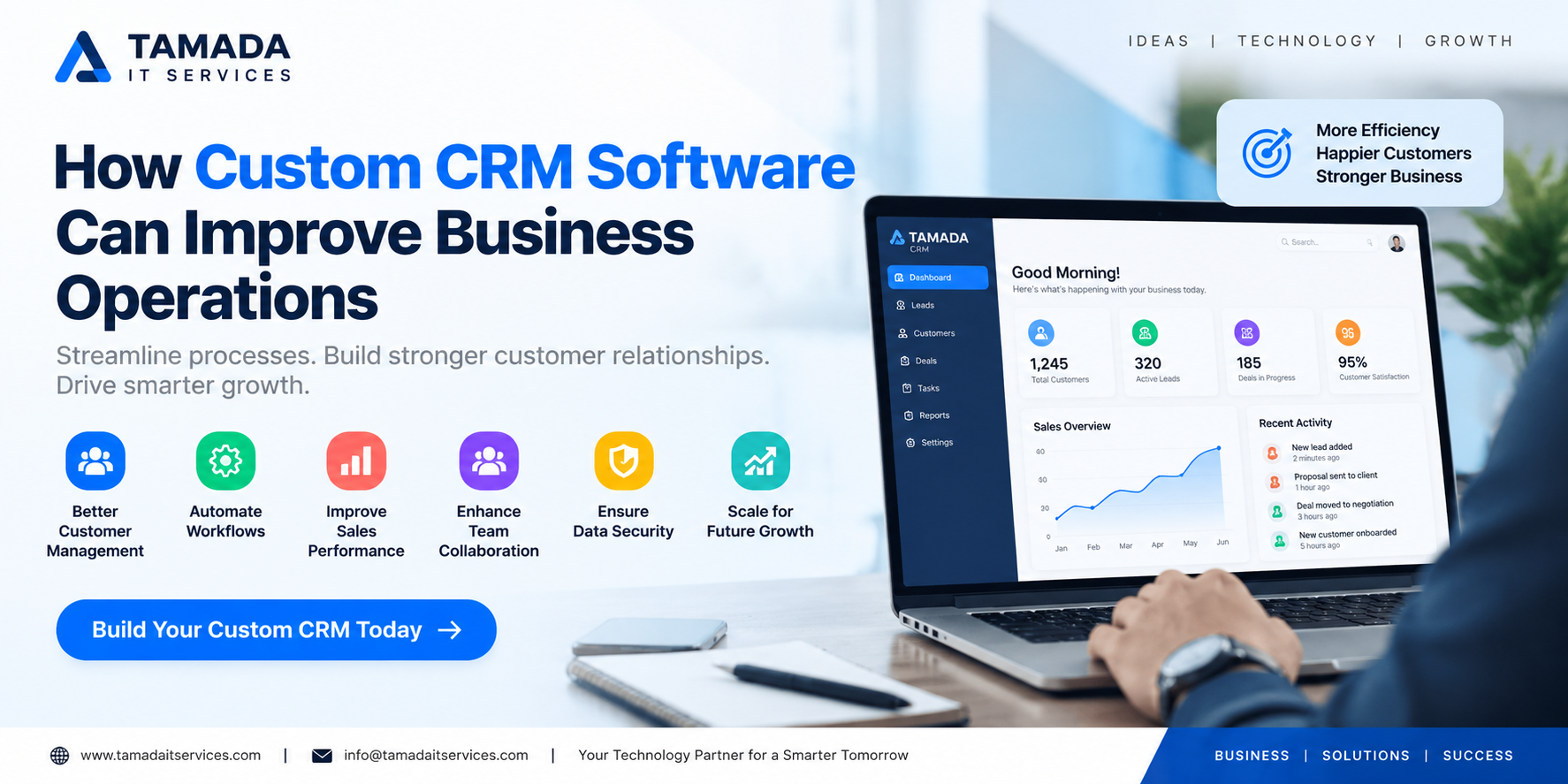
In today's competitive business environment, managing customers, sales, employees, and daily operations efficiently is essential for sustainable growth. Businesses often use spreadsheets, multiple software applications, and manual processes to manage important information. However, these disconnected systems can lead to errors, lost data, and reduced productivity.
This is where custom CRM software can make a significant difference.
A Custom Customer Relationship Management (CRM) system is designed specifically around the unique requirements of your business. Unlike ready-made CRM platforms, custom CRM software allows businesses to build features, workflows, and integrations that match their operations.
In this article, we'll explore how custom CRM software can improve business operations and help organizations achieve better efficiency, customer satisfaction, and growth.
What Is Custom CRM Software?
Custom CRM software is a customer relationship management system developed specifically for a company's unique business processes and requirements.
A CRM system typically helps businesses manage:
- Customer information
- Sales leads
- Sales pipelines
- Customer communication
- Employee activities
- Marketing campaigns
- Customer support
- Business reports and analytics
However, every business operates differently. A standard CRM may include unnecessary features or lack important functionality.
With custom CRM software development, businesses can create a platform that perfectly matches their workflow.
1. Centralized Customer Information
One of the biggest advantages of custom CRM software is the ability to store all customer information in one centralized location.
Instead of searching through spreadsheets, emails, and multiple applications, employees can access important customer data from a single platform.
A custom CRM can store:
- Customer names and contact details
- Purchase history
- Communication records
- Support requests
- Sales activities
- Customer preferences
- Follow-up schedules
This centralized approach helps employees understand customers better and provide faster and more personalized service.
Better Customer Experience
When employees have access to complete customer information, they can respond quickly and provide more relevant solutions.
This can significantly improve customer satisfaction and build stronger long-term relationships.
2. Automating Repetitive Business Tasks
Many businesses spend a large amount of time performing repetitive administrative tasks.
Custom CRM software can automate many of these processes.
For example, a CRM system can automatically:
- Send follow-up emails
- Assign leads to sales representatives
- Generate invoices
- Create reminders
- Update customer records
- Send notifications
- Schedule follow-up calls
- Generate business reports
Automation reduces manual work and allows employees to focus on more important tasks.
Increased Productivity
By reducing repetitive work, employees can spend more time on activities such as:
- Building customer relationships
- Closing sales
- Improving services
- Developing new business opportunities
This leads to improved productivity across the organization.
3. Improved Sales Management
Sales teams often manage multiple leads and customers simultaneously. Without a proper system, it can be difficult to track where each customer is in the sales process.
A custom CRM system can provide a clear sales pipeline.
For example:
New Lead → Contacted → Interested → Proposal Sent → Negotiation → Closed
Sales teams can easily track customer progress and identify opportunities that require immediate attention.
Better Lead Management
Custom CRM software can help businesses:
- Capture leads automatically
- Categorize leads
- Assign leads to sales representatives
- Track lead activity
- Schedule follow-ups
- Measure conversion rates
This ensures that valuable sales opportunities are not lost.
4. Better Workflow Management
Every business has its own processes and workflows.
For example, a service company may follow this process:
Customer Inquiry → Requirement Analysis → Proposal → Project Approval → Development → Delivery → Support
A custom CRM system can be designed to manage the entire workflow.
This helps businesses track every stage of an operation and ensures that employees follow a structured process.
Customized Workflows
Unlike ready-made CRM platforms, custom CRM software allows businesses to create workflows based on their specific requirements.
This makes the software easier for employees to use and improves overall efficiency.
5. Improved Team Collaboration
Communication between departments is essential for smooth business operations.
Sales teams, customer support teams, marketing teams, and management often need access to the same information.
Custom CRM software can create a centralized collaboration platform.
Employees can:
- Share customer information
- Assign tasks
- Add notes
- Track project progress
- Communicate internally
- Monitor employee activities
This reduces communication gaps and ensures that everyone has access to updated information.
6. Data-Driven Business Decisions
Modern businesses generate large amounts of data every day.
However, data is only valuable when businesses can analyze and use it effectively.
Custom CRM software can provide detailed reports and dashboards to help management understand business performance.
For example, businesses can track:
- Total sales
- Monthly revenue
- Lead conversion rates
- Customer acquisition costs
- Employee performance
- Customer retention rates
- Sales trends
These insights help business owners and managers make better decisions.
Real-Time Business Insights
A custom dashboard can display important business information in real time.
Instead of manually preparing reports, management can quickly access important metrics and monitor business performance.
7. Better Customer Support
Customer support plays a major role in building customer loyalty.
Custom CRM software can help businesses manage customer requests efficiently.
A CRM system can include:
- Support ticket management
- Customer communication history
- Automated responses
- Issue tracking
- Support team assignment
- Resolution tracking
This ensures that customer issues are handled quickly and efficiently.
Faster Response Times
When support teams have access to complete customer information, they can understand problems faster and provide better solutions.
This leads to improved customer satisfaction and stronger customer relationships.
8. Integration With Other Business Systems
Businesses often use multiple software applications.
For example:
- Accounting software
- E-commerce platforms
- Payment gateways
- Email marketing tools
- ERP systems
- Inventory management systems
A custom CRM can integrate with these platforms.
This allows information to move automatically between different systems.
Example
An e-commerce business can integrate its CRM with its website.
When a customer places an order:
- Customer information is automatically added to the CRM.
- Order details are stored.
- The sales team receives notifications.
- Marketing campaigns can be personalized.
- Customer support can access the complete order history.
This reduces manual data entry and improves operational efficiency.
9. Increased Business Scalability
As businesses grow, managing customers and operations becomes more complex.
A custom CRM system can be designed to scale with the business.
New features can be added when needed, including:
- Additional employee accounts
- New sales processes
- Advanced analytics
- Mobile applications
- AI-powered features
- Marketing automation
- Customer portals
This flexibility makes custom CRM software a long-term technology investment.
10. Improved Data Security
Customer and business information is valuable and must be protected.
Custom CRM software can include security features based on your company's requirements.
These features may include:
- Role-based access control
- Secure authentication
- Data encryption
- Activity tracking
- Backup systems
- Two-factor authentication
- Access permissions
Businesses can control exactly who has access to specific information.
This helps improve data security and reduce the risk of unauthorized access.
Custom CRM vs Ready-Made CRM Software
While ready-made CRM systems can be useful for some businesses, organizations with unique workflows may benefit significantly from a custom solution.
Which Businesses Can Benefit From Custom CRM Software?
Custom CRM software can be useful for businesses across many industries.
Small and Medium Businesses
Growing businesses can use CRM software to manage customers, sales, and employees efficiently.
Real Estate Companies
Real estate businesses can manage:
- Property leads
- Customer inquiries
- Property visits
- Agent activities
- Sales pipelines
Healthcare Organizations
Healthcare businesses can manage appointments, patient communication, and operational workflows.
E-Commerce Businesses
E-commerce companies can manage customer information, orders, support requests, and marketing campaigns.
Service-Based Businesses
Companies providing IT services, consulting, marketing, or other services can manage clients and projects using a customized CRM system.
Key Features to Include in Custom CRM Software
When developing a custom CRM system, businesses should consider including the following features:
- Customer management
- Lead management
- Sales pipeline
- Task management
- Employee management
- Workflow automation
- Reporting and analytics
- Email integration
- Mobile access
- Role-based permissions
- Customer support management
- Third-party integrations
The exact features should depend on the company's business model and operational requirements.
How Tamada IT Services Can Help Build Custom CRM Software
At Tamada IT Services, we help businesses develop custom software solutions designed around their unique requirements.
Our custom CRM development solutions can help businesses:
- Streamline daily operations
- Automate repetitive tasks
- Improve customer management
- Track sales and leads
- Integrate multiple business systems
- Improve employee productivity
- Generate real-time business insights
We focus on developing scalable, secure, and user-friendly CRM solutions that support long-term business growth.
Whether you are a startup, small business, or growing enterprise, a custom CRM system can help you manage your operations more efficiently.
Conclusion
Custom CRM software is more than just a tool for managing customer information. It can become a central platform for managing sales, operations, employees, customer support, and business data.
By automating workflows, centralizing information, improving collaboration, and providing valuable business insights, custom CRM software can significantly improve business operations.
If your business is currently managing operations through spreadsheets, multiple applications, or manual processes, investing in a custom CRM solution could be an important step toward digital transformation.
Looking for Custom CRM Software Development?
Tamada IT Services can help you design and develop a CRM solution tailored specifically to your business requirements.
Contact us today to discuss your custom CRM software development needs and build a solution that supports your business growth.
Frequently Asked Questions (FAQs)
1. What is custom CRM software?
Custom CRM software is a customer relationship management system developed specifically according to a company's unique business processes and requirements.
2. Why should a business choose custom CRM software?
Businesses should choose custom CRM software when they have unique workflows, require specific integrations, or need features that are not available in standard CRM platforms.
3. Can custom CRM software integrate with existing business systems?
Yes. Custom CRM software can integrate with accounting systems, e-commerce platforms, payment gateways, ERP systems, email tools, and other business applications.
4. Is custom CRM software suitable for small businesses?
Yes. A custom CRM can be developed based on the size and requirements of a small business and can scale as the business grows.
5. How does CRM software improve business productivity?
CRM software improves productivity by automating repetitive tasks, centralizing information, improving team collaboration, and helping employees manage customers and sales more efficiently.
Suggested Blog Category: Software Development / Business Technology
Primary Keyword: Custom CRM Software
Suggested CTA: Build Your Custom CRM with Tamada IT Services