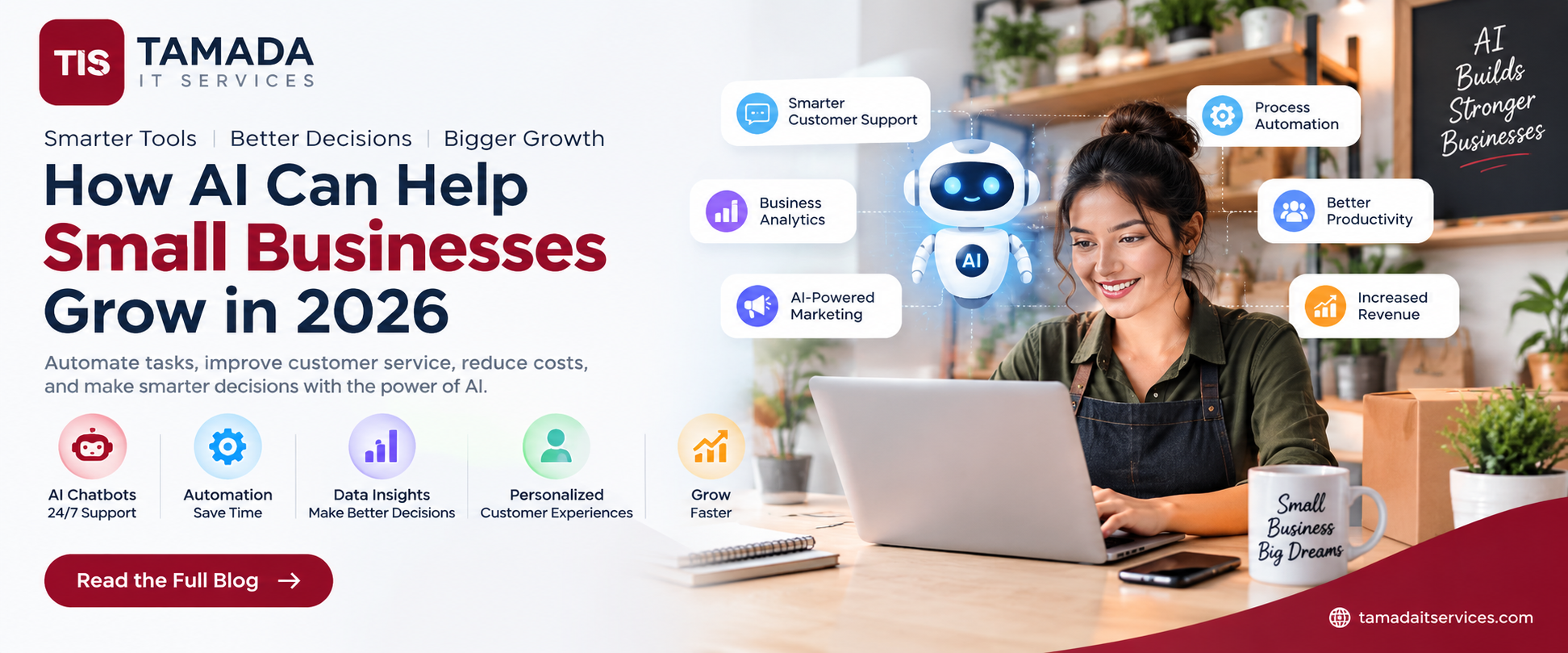
Artificial Intelligence (AI) is no longer a technology reserved for large corporations and global technology companies. In 2026, small businesses can use AI to automate everyday tasks, improve customer service, analyze business data, create marketing content, and operate more efficiently.
For small businesses, one of the biggest advantages of AI is its ability to help teams achieve more without significantly increasing operational costs.
From AI-powered chatbots and automated customer support to intelligent data analysis and workflow automation, AI is changing how businesses operate.
In this article, we'll explore how AI can help small businesses grow in 2026 and how business owners can begin integrating artificial intelligence into their daily operations.
What Is Artificial Intelligence in Business?
Artificial Intelligence refers to technology that enables software and computer systems to perform tasks that traditionally require human intelligence.
These tasks may include:
- Understanding customer questions
- Analyzing data
- Identifying patterns
- Generating content
- Making predictions
- Automating workflows
- Providing recommendations
For businesses, AI can be integrated into websites, mobile applications, CRM systems, customer support platforms, and other business software.
The goal is not necessarily to replace employees. Instead, AI can help employees work faster, reduce repetitive tasks, and make better decisions.
Small businesses often operate with limited resources and smaller teams. Employees may be responsible for multiple tasks, including customer service, sales, marketing, administration, and operations.
AI can help reduce this workload.
For example, instead of manually responding to every customer inquiry, an AI chatbot can answer common questions.
Instead of manually analyzing hundreds of sales records, AI-powered software can identify trends and provide useful insights.
AI gives small businesses an opportunity to:
- Save time
- Reduce repetitive work
- Improve productivity
- Provide better customer experiences
- Analyze business data
- Automate workflows
- Scale operations efficiently
One of the biggest benefits of AI for small businesses is automation.
Many businesses still spend significant time on repetitive administrative tasks.
These tasks may include:
- Entering customer information
- Sending follow-up emails
- Scheduling appointments
- Generating reports
- Categorizing customer inquiries
- Updating records
- Managing routine communication
AI-powered automation can reduce the amount of manual work required.
Example of AI Automation
Imagine a customer submits an inquiry through your business website.
An AI-powered system can automatically:
- Analyze the customer's inquiry.
- Identify the type of service requested.
- Send an initial response.
- Add the customer to your CRM system.
- Assign the lead to the appropriate employee.
- Schedule a follow-up reminder.
This can save valuable time and help businesses respond to potential customers faster.
Customer service is extremely important for small businesses.
However, responding to every customer inquiry manually can be challenging, especially outside regular business hours.
AI chatbots can help businesses provide faster responses.
An AI chatbot can be integrated into:
- Business websites
- E-commerce websites
- Mobile applications
- Customer portals
- Messaging platforms
What Can an AI Chatbot Do?
An AI chatbot can help customers with:
- Frequently asked questions
- Product information
- Service details
- Order status
- Appointment booking
- Basic troubleshooting
- Lead generation
For more complex questions, the chatbot can transfer the customer to a human employee.
Benefits of AI Chatbots
- Faster customer responses
- 24/7 availability
- Reduced support workload
- Improved customer experience
- Better lead collection
AI chatbots can be particularly useful for small businesses that do not have a large customer support team.
Businesses generate valuable information every day.
This information may include:
- Sales data
- Customer behavior
- Website traffic
- Product performance
- Marketing performance
- Inventory information
However, manually analyzing large amounts of information can be difficult.
AI-powered analytics can help businesses identify important patterns and trends.
For example, AI can help answer questions such as:
- Which products are performing best?
- Which customers are most likely to make another purchase?
- Which marketing campaigns are generating leads?
- Which services are most profitable?
- When does customer demand increase?
These insights can help business owners make more informed decisions.
Marketing is another area where AI can provide significant value.
Small businesses often need to create content, manage campaigns, understand customer behavior, and generate leads with limited resources.
AI tools can assist with marketing activities such as:
- Content ideas
- Email campaigns
- Social media content
- Customer segmentation
- Marketing automation
- Campaign analysis
- Personalized recommendations
Personalized Marketing
AI can help businesses understand customer preferences and deliver more relevant communication.
For example, an e-commerce business could recommend products based on:
- Previous purchases
- Customer interests
- Browsing behavior
- Popular products
Personalized marketing can help businesses create stronger relationships with customers.
Sales teams often spend a large amount of time managing leads and following up with potential customers.
AI can help improve this process.
AI-powered CRM systems can assist businesses with:
- Lead scoring
- Customer analysis
- Follow-up reminders
- Sales predictions
- Automated communication
- Lead categorization
AI Lead Scoring
Not every lead has the same potential to become a customer.
AI can analyze customer interactions and help businesses identify leads that may have a higher chance of conversion.
This allows sales teams to focus their time on the most valuable opportunities.
Reducing unnecessary costs is important for every small business.
AI can help reduce operational costs by automating repetitive tasks and improving efficiency.
For example, automation can reduce the time required for:
- Customer support
- Data entry
- Report generation
- Lead management
- Appointment scheduling
- Internal communication
When employees spend less time on repetitive tasks, they can focus on more valuable business activities.
Over time, improved efficiency can help businesses operate with better resource utilization.
Businesses that sell physical products need to manage inventory carefully.
Too much inventory can increase costs, while insufficient inventory can result in lost sales.
AI can help businesses analyze historical data and identify patterns in customer demand.
AI-powered inventory systems can assist with:
- Demand forecasting
- Stock monitoring
- Low inventory alerts
- Product performance analysis
- Purchase recommendations
This can help businesses make smarter inventory decisions.
Business process automation involves using technology to automate routine business workflows.
AI can make automation more intelligent.
Traditional automation follows predefined rules.
For example:
If a customer submits a form → Send an email.
AI-powered automation can analyze the information and determine the most appropriate action.
For example:
Customer submits an inquiry → AI analyzes the request → Categorizes the lead → Assigns it to the correct department → Generates a personalized response.
This creates smarter and more efficient business workflows.
AI can act as a digital assistant for employees.
Instead of spending hours searching for information or completing repetitive tasks, employees can use AI-powered tools to work more efficiently.
AI can help employees:
- Summarize documents
- Generate reports
- Analyze information
- Draft emails
- Organize tasks
- Search business knowledge
- Create content
The goal is to help employees complete tasks faster and focus on work that requires creativity, strategy, and human interaction.
Modern customers expect fast, convenient, and personalized experiences.
AI can help businesses understand customers better.
For example, AI-powered systems can help businesses:
- Recommend relevant products
- Provide personalized offers
- Respond to customer questions
- Identify customer preferences
- Send timely follow-up messages
A better customer experience can improve:
- Customer satisfaction
- Customer retention
- Brand loyalty
- Repeat purchases
Small businesses can integrate AI into different areas of their operations.
AI Chatbots
Useful for:
- Customer support
- Lead generation
- Website communication
- Frequently asked questions
AI-Powered CRM Systems
Useful for:
- Lead management
- Customer insights
- Sales automation
- Follow-up management
AI Business Analytics
Useful for:
- Sales analysis
- Customer behavior
- Performance reports
- Business forecasting
AI Marketing Automation
Useful for:
- Email marketing
- Customer segmentation
- Campaign analysis
- Content support
AI-Powered Business Assistants
Useful for:
- Task management
- Document analysis
- Internal knowledge
- Employee productivity
Many businesses believe that implementing AI requires a large budget or advanced technical knowledge.
However, businesses can start with simple AI solutions.
Step 1: Identify Your Biggest Business Challenge
Start by identifying repetitive or time-consuming processes.
For example:
- Too many customer inquiries
- Manual lead management
- Repetitive data entry
- Slow customer support
- Difficulty analyzing business data
AI should solve a real business problem.
Step 2: Start With One Use Case
Businesses do not need to automate everything at once.
Start with one area.
For example:
- Add an AI chatbot to your website.
- Automate lead management.
- Use AI for customer support.
- Implement AI-powered reporting.
Once the business sees results, additional AI solutions can be introduced.
Step 3: Integrate AI With Existing Software
AI can become more valuable when integrated with existing business systems.
For example, AI can work with:
- CRM software
- E-commerce platforms
- Mobile applications
- Customer support systems
- ERP systems
Custom AI integration can help businesses create a connected technology ecosystem.
Step 4: Monitor Performance
After implementing AI, businesses should monitor its performance.
Important factors may include:
- Time saved
- Customer response times
- Lead conversion
- Employee productivity
- Customer satisfaction
This helps businesses understand whether the AI solution is delivering real value.
One of the most important developments in business technology is the growing use of AI agents.
An AI agent can perform tasks based on a specific goal or workflow.
For example, an AI sales assistant could potentially help:
- Respond to initial customer inquiries
- Collect customer requirements
- Update CRM records
- Schedule follow-ups
- Notify the sales team
AI agents can help businesses automate more complex workflows.
However, businesses should carefully define permissions, security controls, and human oversight when implementing AI-powered systems.
Although AI offers many benefits, businesses should also consider potential challenges.
Data Security
Businesses must protect customer and company information.
AI systems should follow appropriate security practices and access controls.
Accuracy
AI-generated responses and recommendations should be reviewed when accuracy is critical.
Businesses should avoid relying entirely on AI for important decisions without human oversight.
Integration
AI solutions need to work properly with existing business software.
Proper planning and development are important for successful integration.
Employee Training
Employees may need training to understand how to use AI tools effectively.
Businesses should focus on helping employees use AI as a productivity tool.
At Tamada IT Services, we help businesses explore and implement technology solutions based on their unique requirements.
Our AI and software development solutions can help businesses with:
- AI-powered business automation
- AI chatbot development
- Custom software development
- CRM development
- Web application development
- Mobile app development
- AI integration
- Workflow automation
- Business analytics solutions
Every business has different challenges.
Instead of implementing technology simply because it is trending, businesses should focus on AI solutions that solve real operational problems and deliver measurable value.
AI is expected to become an increasingly important part of everyday business operations.
In the future, more businesses may use AI to:
- Automate workflows
- Improve customer interactions
- Analyze business data
- Personalize customer experiences
- Improve employee productivity
Small businesses that begin exploring AI today can better understand how technology can support their long-term growth.
The most successful approach is to start small, focus on a clear business problem, measure the results, and gradually expand AI adoption.
Artificial Intelligence is creating new opportunities for small businesses to compete, grow, and operate more efficiently.
From AI chatbots and business automation to intelligent analytics and personalized customer experiences, AI can help businesses save time and improve productivity.
However, successful AI adoption is not simply about using the latest technology.
The key is to identify real business challenges and implement AI solutions that provide meaningful results.
For small businesses in 2026, AI can become a powerful tool for improving operations, supporting employees, enhancing customer experiences, and building a stronger foundation for future growth.
Ready to Explore AI for Your Business?
Tamada IT Services can help you identify opportunities for AI-powered automation and develop custom technology solutions for your business.
Whether you need an AI chatbot, business automation system, custom CRM, web application, or AI integration, the right technology solution can help your business work smarter and grow faster.
1. How can AI help small businesses?
AI can help small businesses automate repetitive tasks, improve customer service, analyze business data, manage leads, improve marketing, and increase employee productivity.
2. Is AI expensive for small businesses?
The cost depends on the type of AI solution. Small businesses can start with simple AI tools or targeted automation solutions and expand as their requirements grow.
3. Can AI replace employees?
AI is best used to support employees by automating repetitive tasks and improving productivity. Human employees are still important for decision-making, creativity, customer relationships, and complex tasks.
4. What is the best way for a small business to start using AI?
The best approach is to identify one important business challenge and implement AI to solve that specific problem. Businesses can then expand their AI usage based on results.
5. Can AI be integrated with existing business software?
Yes. AI can be integrated with CRM systems, websites, mobile apps, e-commerce platforms, customer support systems, and other business software.
6. What are AI agents in business?
AI agents are AI-powered systems designed to perform tasks or assist with workflows based on defined goals, instructions, and available information.
7. Is AI safe for business use?
AI can be used safely when businesses implement appropriate security measures, access controls, data protection practices, and human oversight.
Suggested CTA: Transform Your Business With AI-Powered Solutions from Tamada IT Services