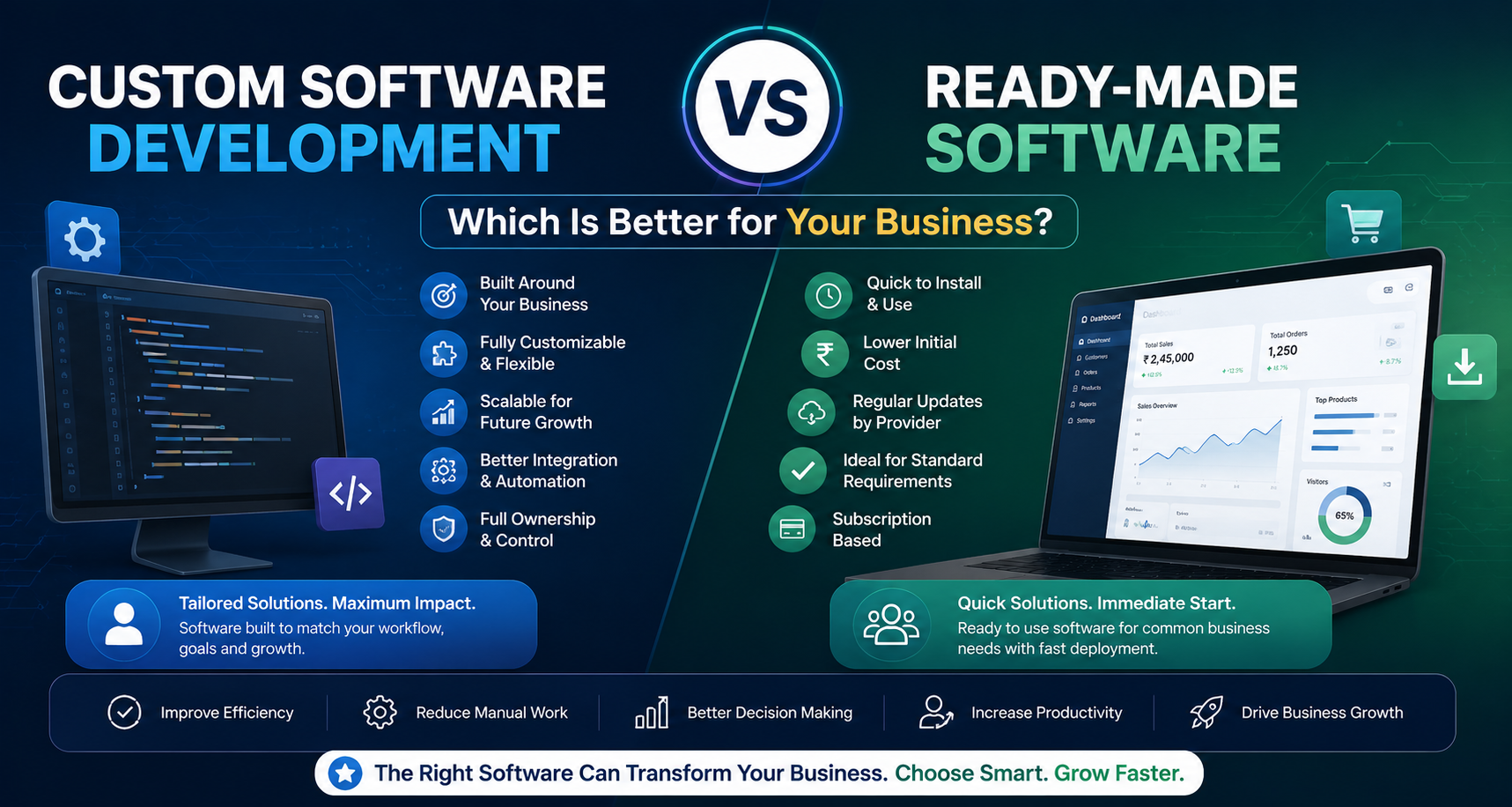
Choosing the right software can have a major impact on how efficiently your business operates.
Today, businesses have two main options: buy ready-made software or invest in custom software development.
Ready-made software can be installed and used quickly, often with a lower initial cost. Custom software, on the other hand, is built specifically around your company's processes, requirements and future goals.
So, which option is better?
The answer depends on your business size, budget, workflow, growth plans and the problems you want the software to solve.
In this guide, we'll compare custom software development vs ready-made software, including their costs, advantages, disadvantages, scalability, security, flexibility and long-term value.
What Is Ready-Made Software?
Ready-made software is a pre-built application developed for a large number of businesses.
Examples include:
-
Accounting software
-
CRM software
-
Project management tools
-
Payroll software
-
Inventory management software
-
HR software
-
Email marketing platforms
-
Billing software
-
Communication tools
Instead of building software from scratch, you subscribe to or purchase an existing product and configure it for your business.
Advantages of Ready-Made Software
The biggest advantage is speed.
You can usually:
-
Sign up
-
Configure your account
-
Add employees
-
Import data
-
Start using the software
There is no need to spend months designing and developing the entire system.
Ready-made software can also be relatively affordable because development costs are distributed across thousands of customers.
Disadvantages of Ready-Made Software
The biggest limitation is that your business has to adapt to the software.
You may find that:
-
A feature you need doesn't exist
-
Your workflow doesn't match the software
-
Customization is limited
-
You have to pay for features you don't use
-
Integrations may be restricted
-
Subscription costs increase over time
-
You depend on the software provider
For a business with unique processes, these limitations can become frustrating.
What Is Custom Software Development?Custom software is designed and developed specifically for a particular business or organization.
Instead of changing your workflow to match an existing product, the software is designed around your requirements.
Custom software can include:
-
Business management systems
-
CRM platforms
-
ERP systems
-
Employee management systems
-
Inventory systems
-
Customer portals
-
Vendor portals
-
Booking platforms
-
SaaS applications
-
Business automation systems
-
Internal dashboards
-
Custom billing systems
The software can be developed with the features, workflows and integrations your business actually needs.
Custom Software vs Ready-Made SoftwareHere's a quick comparison:
Feature Ready-Made Software Custom Software Initial Cost Usually lower Usually higher Development Time Very low Higher Customization Limited to moderate Very high Scalability Depends on provider Designed for your needs Features Predefined Built as required Integrations Available options Can be customized Ownership Usually provider-controlled Can be owned by business Workflow Business adapts to software Software adapts to business Updates Provider controlled Controlled by development team Long-Term Flexibility Limited High Unique Business Requirements May be difficult Ideal Subscription Dependency Common Can be reduced When Should You Choose Ready-Made Software?Ready-made software can be the right choice when your requirements are standard.
For example, suppose you run a small business and simply need:
-
Invoicing
-
Basic accounting
-
Employee attendance
-
Customer management
-
Email marketing
There may already be excellent software available for these requirements.
Building your own system from scratch may not make financial sense.
Ready-made software is often suitable when:
-
You need software immediately
-
Your requirements are standard
-
Your budget is limited
-
You don't need extensive customization
-
You don't need complex integrations
-
You are testing a new business idea
-
You want predictable monthly costs
In these situations, buying existing software can save both time and money.
When Should You Choose Custom Software?Custom development becomes more attractive when your business has unique processes that existing software cannot handle efficiently.
For example, imagine a company that manages hundreds of employees, vendors, customers and internal processes.
The company may currently use:
-
Excel spreadsheets
-
WhatsApp
-
Email
-
Accounting software
-
CRM software
-
Separate HR software
Employees may be manually transferring information between different systems.
A custom platform could bring these workflows together.
For example:
Customer → Sales → Order → Invoice → Payment → Delivery → Reporting
Instead of managing each stage separately, everything can be connected through one system.
Custom software is particularly useful when:
-
Your business has unique workflows
-
Existing software doesn't meet your requirements
-
Multiple systems need to communicate
-
You need advanced automation
-
You require custom dashboards
-
You need specific user roles and permissions
-
You expect significant business growth
-
Software is becoming a core part of your business
-
You want greater control over your technology
Cost is one of the biggest differences between the two options.
Ready-Made Software Cost
Ready-made software often follows a subscription model.
You may pay:
-
Monthly
-
Annually
-
Per user
-
Per feature
-
Based on usage
For a small company, this can be an affordable way to get started.
However, the total cost can become significant as the business grows.
For example:
10 users × ₹1,000/month = ₹10,000/month
That's:
₹1,20,000 per year
Over several years, subscription costs can become substantial.
Custom Software CostCustom software normally requires a larger initial investment.
The cost depends on:
-
Number of modules
-
User roles
-
UI/UX design
-
Backend development
-
Database architecture
-
APIs
-
Third-party integrations
-
Automation
-
Security requirements
-
Mobile applications
-
Admin dashboards
-
Testing
-
Hosting infrastructure
A simple internal business application may cost significantly less than a large SaaS platform.
This is why custom software should be quoted based on requirements and scope, rather than using one fixed price for every project.
Custom Software Has a Higher Initial Cost — But What About ROI?Looking only at development cost can be misleading.
Consider a business that spends several hours every day manually performing repetitive tasks.
Employees may be:
-
Copying data between systems
-
Creating reports manually
-
Sending repetitive messages
-
Updating spreadsheets
-
Checking orders
-
Generating invoices
-
Following up with customers
If custom software automates these tasks, the company may save hundreds of employee hours every month.
For example:
5 hours saved per day × 25 working days = 125 hours saved per month
Over a year, that becomes:
1,500 hours saved.
The real question isn't simply:
"How much does the software cost?"
It is:
Scalability"How much time, money and operational effort can the software save over its lifetime?"
Business requirements change as a company grows.
A solution that works for 10 employees may not work efficiently for 100 employees.
Ready-made software may provide different pricing plans and features, but you're ultimately dependent on what the software provider offers.
With custom software, the system can be designed with future growth in mind.
You can add:
-
New departments
-
New user roles
-
New branches
-
New workflows
-
New integrations
-
Additional reporting
-
Mobile applications
-
Automation
-
AI-powered features
This makes custom development particularly attractive for growing businesses.
CustomizationThis is one of the biggest advantages of custom software.
With ready-made software, you generally choose from the features the provider has already built.
With custom development, functionality can be designed specifically for your organization.
For example, a company might require:
Employee → Manager → Finance → Admin
with different permissions at every stage.
A custom system can implement exactly this workflow.
You can also define:
-
Who can create records
-
Who can approve them
-
Who can edit them
-
Who can delete them
-
Who can view financial information
-
Who receives notifications
This level of control can be difficult to achieve with generic software.
Integration With Other SystemsModern businesses rarely use just one application.
You may need to connect your software with:
-
Payment gateways
-
Accounting systems
-
CRM platforms
-
Email services
-
SMS providers
-
WhatsApp services
-
Shipping APIs
-
Government APIs
-
Cloud storage
-
Analytics platforms
-
Mobile applications
Ready-made software may support some integrations, but you are limited to the integrations provided by the vendor.
Custom software can be designed around your specific integration requirements.
Security and Data ControlData is one of the most important assets of a modern business.
With ready-made software, your data is generally stored and managed according to the provider's infrastructure and policies.
With custom software, your organization can have greater control over:
-
Database architecture
-
User permissions
-
Authentication
-
Access control
-
Backup strategy
-
Hosting environment
-
Data retention
-
Security policies
However, custom software is not automatically more secure.
Security depends on how the system is designed, developed, hosted and maintained.
A professionally developed application should include appropriate security practices from the beginning.
Speed of ImplementationIf you need software immediately, ready-made software has a major advantage.
You can often start using it within hours or days.
Custom software takes longer because the development process usually involves:
-
Requirement analysis
-
Planning
-
UI/UX design
-
Architecture
-
Development
-
Testing
-
Deployment
-
Training
-
Maintenance
A complex application can take weeks or months to develop.
However, the longer development process gives you something important:
Software designed around your business.
Ownership and Vendor DependencyAnother important consideration is ownership.
With many ready-made applications, you are essentially renting access to the software.
If the provider:
-
Changes pricing
-
Removes a feature
-
Changes its API
-
Discontinues the product
-
Changes its policies
your business may be affected.
Custom software can provide greater control, depending on the agreement and ownership structure.
Before starting a custom development project, businesses should clearly understand:
-
Who owns the source code
-
Who owns the database
-
Where the application is hosted
-
Who controls the domain
-
Who manages the server
-
What happens after development is completed
These details should be clearly documented.
Which Is Better for Small Businesses?For many small businesses, ready-made software is an excellent starting point.
If your requirements are simple and standard, there's no reason to spend a large amount of money building something that already exists.
However, custom software becomes more attractive when:
-
Your business processes are unique
-
You are spending too much time on manual work
-
Multiple tools are being used together
-
Existing software is limiting your growth
-
You need automation
-
Your business depends heavily on technology
The right choice is based on the problem you are trying to solve.
Which Is Better for Growing Businesses?Growing businesses often reach a point where generic tools become difficult to manage.
For example:
A business starts with Excel.
Then it adds accounting software.
Then CRM.
Then HR software.
Then inventory software.
Then separate reporting tools.
Eventually, employees spend more time moving data between systems than actually using it.
This is often the point where a custom business management platform becomes worth considering.
A centralized platform can connect different processes and provide a single source of information.
Hybrid Approach: You Don't Have to Choose ImmediatelyThere is another option.
You don't always have to replace every existing system with custom software.
A business can take a hybrid approach.
For example:
-
Keep existing accounting software
-
Keep existing payment gateway
-
Build a custom CRM
-
Connect the CRM to accounting
-
Automate notifications
-
Build a custom management dashboard
This can provide many of the benefits of custom development without rebuilding everything from scratch.
How to Decide Between Custom and Ready-Made SoftwareAsk yourself these questions:
1. Are my business processes standard?
If yes, ready-made software may be sufficient.
2. Do I need features that existing software doesn't provide?
If yes, custom development may be worth considering.
3. Are employees spending too much time on repetitive tasks?
If yes, automation or custom software could provide significant value.
4. Do I need multiple systems to communicate?
If yes, custom integrations may help.
5. Is the software becoming critical to my business?
If software is directly connected to your competitive advantage, greater control may be valuable.
6. Will my requirements change as the company grows?
If yes, scalability should be an important consideration.
Custom Software vs Ready-Made Software: Final VerdictThere is no universal winner.
Ready-made software is usually better when you need a fast, affordable solution for a standard business requirement.
Custom software is usually better when your business requires unique workflows, automation, integrations, scalability and greater control.
The best choice depends on your business—not on which option is more expensive.
Before making a decision, calculate:
Software Cost + Implementation Cost + Training + Maintenance + Subscription Costs + Business Impact
Then compare that against the value the software can provide.
A good software solution should not simply be another expense.
It should help your business save time, reduce manual work, improve accuracy, serve customers better and grow more efficiently.
Build Software Around Your Business With Tamada IT ServicesAt Tamada IT Services, we develop custom software, web applications, SaaS platforms, websites and business automation solutions based on specific business requirements.
Instead of forcing your workflow into a generic system, we can help you plan a solution around your actual processes.
Our development approach can include:
-
Requirement analysis
-
Custom UI/UX
-
Web application development
-
Business automation
-
API integrations
-
Admin dashboards
-
Database development
-
User roles and permissions
-
SaaS development
-
Ongoing maintenance and support
If your current software is limiting your business—or your team is spending too much time on manual processes—a custom software solution may be worth exploring.
Contact Tamada IT Services to discuss your requirements and determine whether custom software or an existing solution is the better choice for your business.
Frequently Asked QuestionsIs custom software better than ready-made software?
Not always. Ready-made software is often better for standard requirements, while custom software is more suitable for unique workflows, automation, integrations and specialized business requirements.
Is custom software more expensive?
Usually, custom software has a higher initial development cost. However, it can provide better long-term flexibility and may reduce recurring software subscriptions and manual operational costs.
How long does custom software development take?
The timeline depends on the project's complexity. A simple internal application may take a few weeks, while a complex ERP, SaaS platform or business management system can take several months.
Can custom software integrate with existing software?
Yes. Custom applications can often be connected with existing systems through APIs and other integration methods, depending on what those systems support.
Can small businesses afford custom software?
Yes. Custom software doesn't necessarily have to be a huge enterprise project. A small business can start with a focused application or MVP and add functionality as the business grows.
Should I build custom software or buy existing software?
Start by identifying your requirements. If an existing product solves your problem effectively at a reasonable cost, buying it may be the better option. If existing products cannot support your workflow, custom development may provide better long-term value.
Who owns custom software?
Ownership depends on the development agreement. Before starting a project, clearly define ownership of the source code, database, design files, domain, hosting and other project assets.